How to Write a Strong Diploma Assignment: A Step-by-Step Guide for Online Learners
A practical guide to diploma assignments: how to read the brief, use command words, plan from the assessment criteria, reference properly and check your work before you submit.
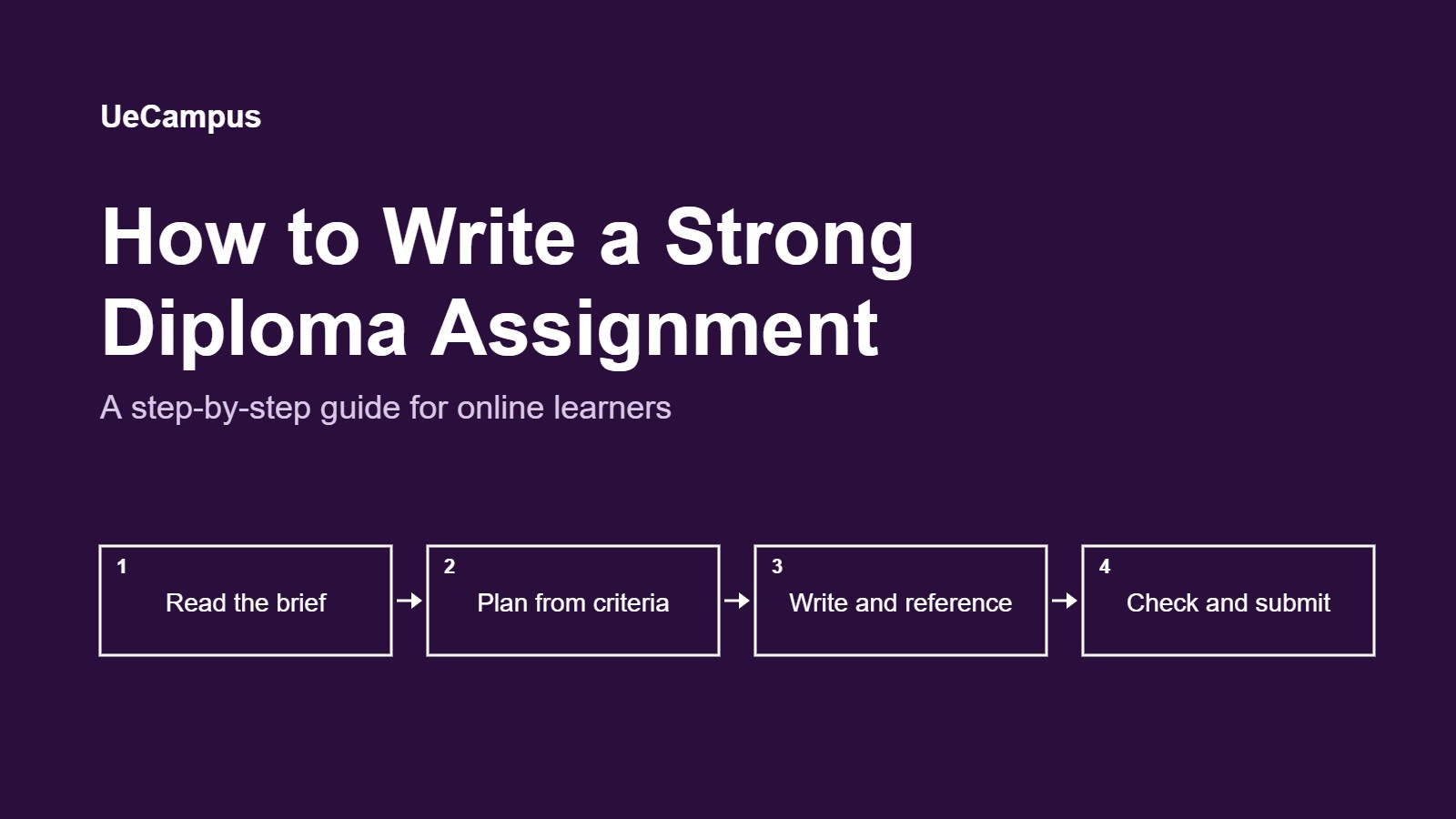
Most UK diplomas studied online with UeCampus are assessed through written assignments rather than exams. That is good news if you are working, because you can plan your time. But it also means your result depends on how well you read the brief, plan your answer and present your evidence.
This guide walks you through the process step by step, with a short worked example, so you can approach your first assignment with confidence.
Before you start: know what you are being marked on
Every unit has learning outcomes and assessment criteria. The assessment criteria are the most important part of the brief, because your marker checks your work against each one.
For Qualifi diplomas, learners must show they have met all assessment criteria for all units to achieve the qualification. In simple terms: a long, well-written answer that misses one criterion can still fall short, while a clear answer that covers every criterion is on solid ground.
If you would like the full picture of marking, grade bands and quality checks, read our guide on how online diplomas are assessed.
Step 1: Read the brief twice
Read the whole brief once to understand the task. Then read it again slowly with a pen or a notes app open, and write down:
- the unit title and the scenario or organisation you must write about
- every assessment criterion, word for word
- the submission date
- any guidance on length, format and referencing from your centre
Do not start writing until you can explain the task in two or three sentences of your own.
Step 2: Understand the command words
Assessment criteria usually start with a verb. That verb tells you how deep your answer needs to go. Here is what the most common ones ask for:
| Command word | What it asks you to do |
|---|---|
| Describe | Say what something is or what happens, clearly and accurately |
| Explain | Say how or why something happens, giving reasons |
| Analyse | Break a topic into parts and show how they connect or affect each other |
| Evaluate | Weigh up strengths and weaknesses and reach a judgement you can justify |
| Discuss | Look at different points of view and bring them together |
| Recommend | Propose a course of action and say why it is the best option |
A common mistake is to describe when the criterion asks you to evaluate. If the verb is "evaluate", your answer needs a judgement, such as "this approach is the stronger option because...".
Step 3: Turn the criteria into your plan
The simplest way to make sure nothing is missed is to use the assessment criteria as the skeleton of your assignment. Give each criterion its own heading or section, in the same order as the brief.
Under each heading, jot down:
- the main point you will make
- the theory or model you will use
- the example or evidence that supports it
- the source you will reference
This plan becomes your checklist. Before you submit, you should be able to point to the exact paragraph that answers each criterion.
Step 4: Research with purpose
Use the learning materials for the unit first, then add a small number of good-quality sources such as textbooks, journal articles and reports from recognised organisations. Avoid relying on anonymous websites or content that cannot be checked.
Keep a running list of every source as you read: author, year, title and where you found it. This saves a lot of time at the end.
Step 5: Apply theory to a real example
Many briefs ask you to apply ideas to an organisation. Where the brief allows, use one you know well, such as your current or past employer. Real examples make your analysis more convincing and show your marker that you understand how the theory works in practice.
If you use information from your workplace, check whether you need permission and leave out anything confidential.
Step 6: Write clearly
You do not need complicated language to do well. Aim for:
- A short introduction that says what the assignment covers and how it is organised.
- One main idea per paragraph, starting with a clear opening sentence.
- Evidence after every claim, with a reference.
- A conclusion that pulls your points together and, where asked, gives your recommendation.
Write in your own words. If you are unsure whether you can use AI writing tools at any stage, ask your tutor before you begin, because centre policies differ.
Step 7: Reference properly
Every idea, figure or quotation that comes from someone else needs a reference in the text and a full entry in your reference list. Use the referencing style your centre asks for, for example Harvard, and apply it the same way throughout.
Good referencing is not just about avoiding plagiarism. It also shows your marker that your points are backed by evidence, which strengthens analysis and evaluation.
Step 8: Check before you submit
Leave time for a final review. Use this checklist:
- Does every assessment criterion have its own clearly labelled section?
- Does each answer match the command word (describe, explain, analyse, evaluate)?
- Is every claim supported by evidence and a reference?
- Have you followed your centre's guidance on length and format?
- Is your reference list complete and consistent?
- Have you read it once out loud, or with a text-to-speech tool, to catch errors?
A short worked example
Here is a made-up brief, for illustration only, showing how the steps fit together.
Scenario: An organisation is introducing a new online customer service system.
Example criteria:
- Explain two reasons why employees may resist change.
- Evaluate one approach to managing resistance to change.
How to plan it:
- Heading 1: Reasons for resistance. The command word is "explain", so for each reason say why it happens. For example, fear of losing skills and uncertainty about job security, each linked to a change management source and an example from the scenario.
- Heading 2: Evaluating an approach. The command word is "evaluate", so choose one approach, set out its strengths and its limitations for this organisation, then finish with a clear judgement on whether it would work and why.
Notice that the plan is built directly from the criteria. That is the habit that makes the biggest difference.
Use feedback to improve every unit
When your marked work comes back, read the feedback carefully and note one or two things to do differently next time. Over a full diploma, steady improvement unit by unit adds up.
Good study habits help too. See our guides on how to study online effectively, how to balance work and online study and what a week of online study actually looks like.
Diplomas you can study online with UeCampus
If you are ready to put these skills to work, these programmes are popular starting points:
- Qualifi Level 3 Diploma in Business Management, a good first step if you are new to higher-level study.
- Qualifi Level 4 Diploma in Business Management, for learners ready to begin university-level business study.
- Qualifi Level 5 Diploma in Extended Business Management, which builds on Level 4 and can lead towards a top-up degree.
- Level 7 Diploma in Strategic Management and Leadership, for experienced professionals.
Browse every option in the UeCampus programme catalogue.
Frequently asked questions
How long should a diploma assignment be?
Length guidance is set by your centre for each assignment brief. Follow it closely, and focus on covering every assessment criterion rather than reaching a word count.
Can I use examples from my job?
Often yes, where the brief allows, and it can make your work stronger. Check whether you need permission and leave out confidential information.
What referencing style should I use?
Use the style your centre asks for and apply it consistently. If you are not told, ask your tutor before you start.
What if I do not understand the brief?
Ask your tutor early. It is much easier to clear up a question at the start than to rewrite an assignment later.
Ready to start?
Assignment-based study rewards good planning more than last-minute effort, and these skills grow with every unit. To find the right diploma and ask about tutor support, enquire now and the UeCampus admissions team will help you plan your next step.
Thinking about studying online?
Explore accredited UeCampus programmes and UK diplomas, or speak to an admissions advisor about the next intake.
Browse programmes Enquire now