What Is an International Foundation Year? Who Needs One and Where It Leads
A foundation year bridges the gap between your school qualifications and a degree. Here is who needs one, what you study, what level it sits at, and the routes it opens up.
If your school-leaving certificate is not accepted for direct entry to a bachelor's degree, you are not stuck. A foundation year is a one-year bridge that brings you up to the level universities expect, and it is one of the most common routes for international students into UK-style higher education.
This guide explains what a foundation year is, who it is designed for, what you actually study, how it fits into the UK qualification levels, and what you can do once you finish.
What is an international foundation year?
An international foundation year (often shortened to IFY) is a preparation programme taken before the first year of an undergraduate degree. It is aimed at students who have the ability and motivation for degree study but do not yet hold the formal qualifications a university asks for.
In the UK, the usual benchmark for degree entry is the A level, or a qualification at the same level. Many national school certificates around the world are not treated as comparable to A levels, so a foundation year fills that gap. It usually covers three things: subject knowledge in your chosen area, academic skills such as essay writing and research, and the study habits you need to succeed at degree level.
Who needs a foundation year?
A foundation year is usually a good fit if one or more of these describes you:
- Your school qualification is not accepted for direct entry. This is common when a national certificate is considered below A level standard.
- Your grades were lower than the entry requirement. A foundation year gives you a fresh, recent result to apply with.
- You want to change subject. If you studied science at school but now want business or psychology, a foundation year gives you grounding in the new subject.
- You have been out of education for a while. Adults returning to study often use a foundation year to rebuild academic confidence before committing to a full degree.
If you already hold A levels, an International Baccalaureate Diploma or another qualification that universities accept, you probably do not need one. When in doubt, check the entry requirements for the specific degree you want.
What level is a foundation year?
Most foundation programmes sit at the same level as A levels. In the Regulated Qualifications Framework (RQF) used in England, Wales and Northern Ireland, that is Level 3. In the Scottish Credit and Qualifications Framework (SCQF), the comparable level is SCQF Level 6, the level of Scottish Highers.
That point matters: a foundation year is pre-degree study. It prepares you for the first year of a bachelor's degree; it is not the first year itself. For a refresher on how the levels fit together, see our guide to UK qualification levels from 1 to 8 and our explainer on SCQF levels.
What do you study?
Content varies by provider and subject route, but most foundation programmes combine:
- Subject modules in the area you plan to study at degree level, such as business, computing or psychology.
- Academic skills, including critical thinking, referencing, report writing and presenting.
- Study and research skills, such as finding and judging sources and managing deadlines.
- English language support in some programmes, although many expect a minimum level of English at entry.
Assessment is usually through assignments, projects and reports rather than a single final exam, which gives you steady practice in the kind of work a degree will ask of you.
Integrated foundation year or standalone foundation diploma?
There are two main types, and the difference affects where you can go next.
Integrated foundation year
Some universities attach a foundation year to a specific degree. You enrol on a four-year programme, and passing the foundation year at the required grade moves you into Year 1 of that degree at the same institution. The route is clear, but you are tied to one university, and it usually means relocating and paying campus fees for the extra year.
Standalone foundation diploma
Other foundation programmes lead to a separate, credit-rated qualification issued by an awarding body. You can then use that qualification to apply for further study. This route is more flexible, and it can often be studied online while you work or stay in your home country. The trade-off is that each university or provider makes its own admissions decision, so check that your intended next step accepts the qualification before you enrol.
Where can a foundation year lead?
A completed foundation qualification at Level 3 can open several next steps, depending on your goals:
- Year 1 of a bachelor's degree, where the receiving institution accepts the qualification.
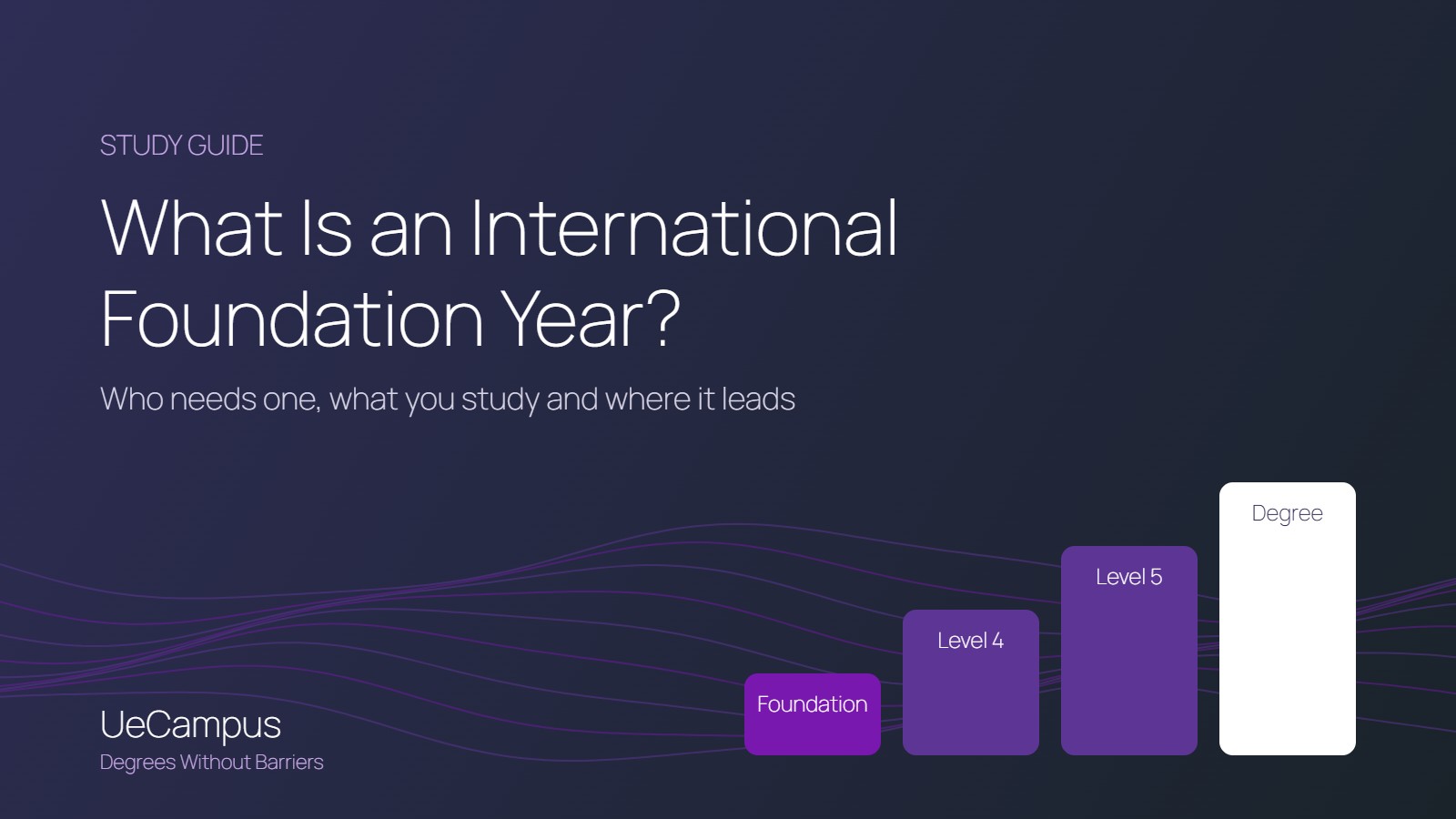
- A Level 4 certificate or diploma, which is the same level as the first year of a UK degree and can be built on step by step.
- A stepped route to a full degree: Level 4, then Level 5, then a one-year top-up degree to complete a bachelor's.
- Employment, using the subject knowledge and skills you have gained.
The stepped route is popular with working adults, because each stage ends with its own qualification. If life gets busy after one level, you still leave with a recognised award rather than an unfinished degree. We look at this approach in more detail in how to get a degree without A levels.
Studying a foundation programme online with UeCampus
UeCampus offers the EduQual Diploma in International Foundation Studies (SCQF Level 6), a 180-credit diploma equivalent to RQF Level 3. It is studied online and lets you build a foundation in computing, psychology or business, with a strong focus on the academic skills you need for higher education.
Once you complete it, you can continue with UeCampus at the next level, for example with the EduQual Certificate in Business and Management (SCQF Level 7), the EduQual Certificate in Psychology (SCQF Level 7) or the EduQual Certificate in Creative Computing (SCQF Level 7). Each of these is equivalent to RQF Level 4.
If you already know you want a business career, the Qualifi Level 3 Diploma in Business Management is another Level 3 starting point. To learn more about the awarding body behind the foundation diploma, read is EduQual recognised?
How to decide if a foundation year is right for you
- Pick your end goal. Write down the degree or career you are aiming for.
- Check the entry requirements for that degree and compare them with what you already hold.
- Confirm the next step accepts your foundation qualification before you enrol, especially if you plan to move to another institution.
- Think about how you want to study. If you need to keep working or stay at home, an online foundation diploma may suit you better than relocating.
- Talk to an adviser who can check your current qualifications and suggest the right starting level.
Frequently asked questions
Is a foundation year the same as the first year of a degree?
No. A foundation year sits at Level 3, the same level as A levels. The first year of a bachelor's degree is Level 4. A foundation year prepares you to start at Level 4.
Can I do a foundation year if I have been out of school for years?
Yes. Many foundation students are adults returning to education. Entry requirements vary, so ask the provider what they need from you.
Will every university accept my foundation diploma?
Not automatically. Each institution sets its own entry rules, so always check with the institution you plan to apply to before you start.
How long does a foundation year take?
Campus programmes typically run for one academic year. Online programmes can be more flexible, so ask admissions for a study plan that fits your schedule.
Next steps
Not sure which level to start at? Share your current qualifications with our admissions team and we will help you find the right starting point. Enquire now or explore the International Foundation Studies diploma.
Thinking about studying online?
Explore accredited UeCampus programmes and UK diplomas, or speak to an admissions advisor about the next intake.
Browse programmes Enquire now