What Is a Top-Up Degree? How a Level 5 Diploma Can Lead to a UK Bachelor's
A top-up degree lets you turn an HND, foundation degree or Level 5 diploma into a full UK bachelor's by studying only the final year. Here is how credits, entry rules and timelines work, and what to check before you apply.
If you already hold an HND, a foundation degree or a Level 5 diploma, you may not need to start a bachelor's degree from the beginning. A top-up degree lets you join a UK honours degree at its final year, finish that one stage, and graduate with the full bachelor's award. This guide explains how top-up degrees work, how credits decide whether you are eligible, and what to check before you apply.
What is a top-up degree?
A top-up degree is the final year of a UK bachelor's degree, taken by someone who has already completed the first two years' worth of study through another qualification. When you pass it, the university awards you its bachelor's degree, usually with honours.
In England, Wales and Northern Ireland, qualifications sit on numbered levels. GOV.UK's guide to what qualification levels mean places the HNC and Certificate of Higher Education at Level 4, the HND, foundation degree and Diploma of Higher Education at Level 5, and a bachelor's degree with honours at Level 6. A top-up degree is the step from Level 5 to Level 6.
Most universities describe a full-time top-up as about one further year of study. Part-time and online versions usually take longer because you study fewer modules at a time.
How credits make a top-up degree work
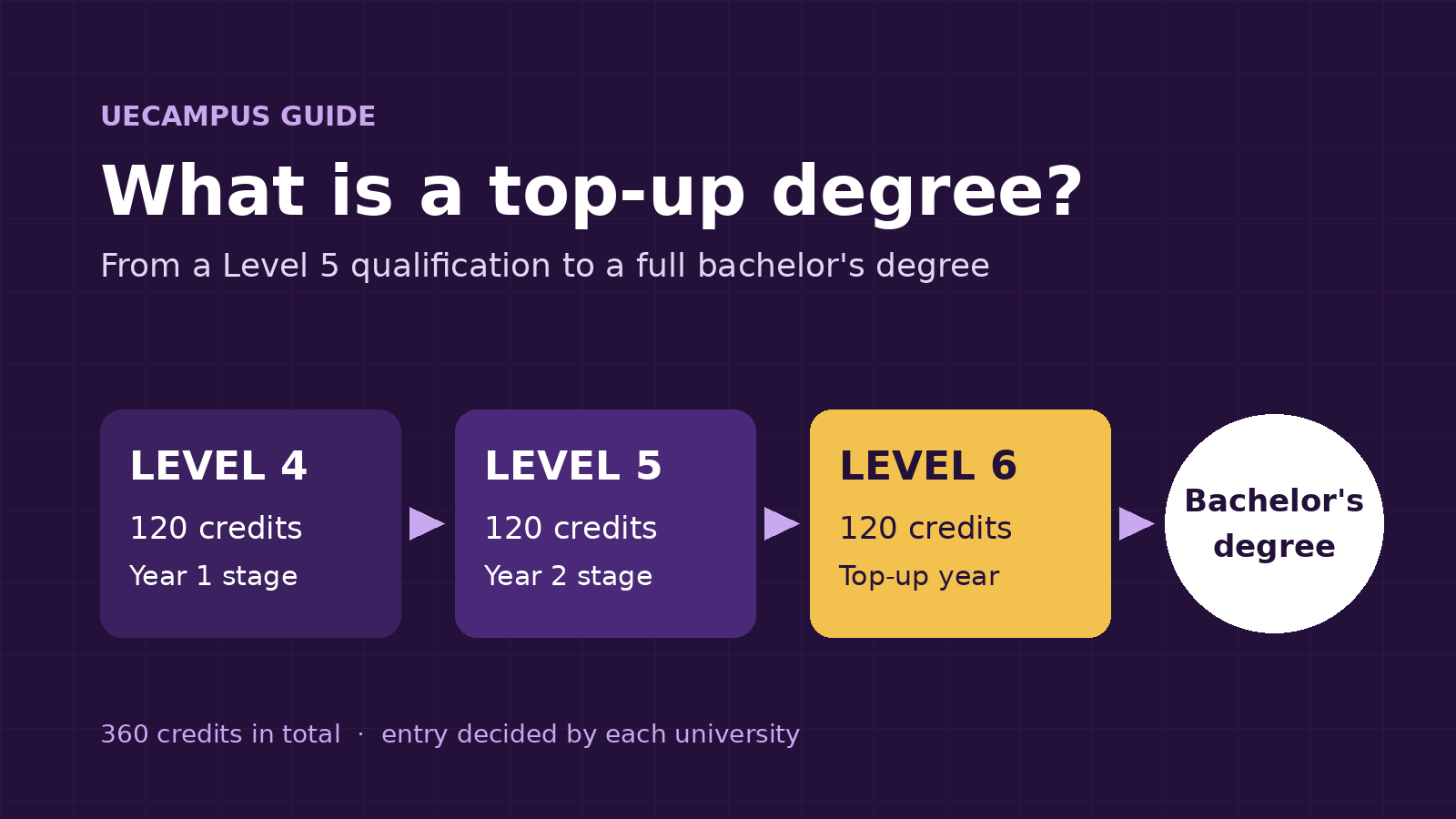
UK degrees are built from credits. According to the Quality Assurance Agency's student guide to credit, a bachelor's degree with honours is usually 360 credits, and one credit represents around 10 hours of learning. A typical three-year degree is split like this:
| Stage | Level | Credits | Examples of qualifications at this level |
|---|---|---|---|
| Year 1 | Level 4 | 120 | HNC, CertHE, Level 4 diploma |
| Year 2 | Level 5 | 120 | HND, foundation degree, DipHE, Level 5 diploma |
| Final year (the top-up) | Level 6 | 120 | Completes the bachelor's degree with honours |
A top-up course provides the final 120 credits at Level 6. To admit you, the university needs to be satisfied that your earlier study covers the first two stages. The QAA is clear that each university decides for itself how it recognises credit from elsewhere, so the same diploma can be accepted by one university and not another.
Why the size of your Level 5 diploma matters
Not every Level 5 qualification is the same size. Some Level 5 diplomas carry 120 credits at Level 5 only. Extended diplomas usually combine Level 4 and Level 5 study in one qualification. For example, the awarding organisation Qualifi states that its Level 5 Extended Diploma in Business Management has a value of 240 credits, and it lists the final year of a UK university honours degree as the progression route.
If your Level 5 diploma is a 120-credit qualification, a university will also want to see how the Level 4 stage is covered, for example through a Level 4 diploma. Check this before you apply, because it can change how long your overall route takes.
Who can apply for a top-up degree?
Universities usually accept one of the following, in a subject related to the degree you want:
- A Higher National Diploma (HND)
- A foundation degree (FdA or FdSc)
- A Diploma of Higher Education (DipHE)
- A Level 5 diploma from a regulated awarding organisation
Beyond the qualification itself, admissions teams normally look at:
- Subject fit. Your earlier study should prepare you for the final-year modules. A business diploma fits a business top-up; it is unlikely to fit a nursing degree.
- Level and credit volume. As explained above, the university needs evidence of both the Level 4 and Level 5 stages.
- Your transcript and grades. Some courses set minimum results.
- English language. If English is not your first language, many universities ask for a recognised test score. The required score varies by course.
- Whether your qualification is regulated. In England, qualifications regulated by Ofqual are listed on the Ofqual Register, which admissions teams can check.
How long does a top-up degree take?
Full-time, a top-up degree typically takes one academic year. Part-time and online top-ups are spread over a longer period, often a little more than a year, depending on how many modules you take at once.
If you are starting from scratch, add the time needed to reach Level 5 first. Plan the whole route, not just the final year.
Top-up degree or a full three-year degree?
| Top-up route | Full bachelor's from Year 1 | |
|---|---|---|
| Starting point | Level 5 qualification already completed | Usually Level 3 qualifications, such as A levels |
| University stage | Final year only | All three years |
| Qualifications along the way | A certificate at each stage you complete | One award at the end, unless you exit early |
| Tuition | Paid to the university for the final year only; add what you paid for your diplomas when comparing | Paid to the university for every year |
| Subject choice | Limited to courses that offer top-up entry | Wider choice |
| Final award | The university's bachelor's degree | The university's bachelor's degree |
Advantages of a top-up degree
- You build your degree in stages. Each diploma is a qualification in its own right, so you have something to show employers even before you graduate.
- It suits working adults. Many diplomas and top-ups can be studied online and part-time, so you can keep earning while you study.
- It can be a second chance. If you left university early or did not meet traditional entry requirements, a regulated diploma can open the door to a degree.
Things to watch out for
- Entry is not automatic. Even a well-matched diploma only makes you eligible to apply. The university makes the final decision.
- The final year is demanding. Level 6 study usually includes independent research, such as a dissertation or major project.
- Fewer subjects are available. Not every degree has a top-up version.
- Recognition depends on where you use it. Rules for employers, licensing bodies and further study differ between countries.
Is a top-up degree recognised?
The degree is awarded by the university, so it carries that university's standing. Whether it is accepted for a particular job, professional licence or postgraduate course depends on the rules of that employer, body or country. If you plan to use your degree outside the UK, for example for a government role or an equivalency process, check the current requirements with the relevant authority before you enrol. Our guide to whether online degrees are recognised explains the questions to ask.
Using a regulated diploma as your route to a top-up degree
For many working adults, the most flexible route to a top-up degree is an online diploma from a regulated awarding organisation. At UeCampus, the Qualifi Level 4 Diploma in Business Management and the Qualifi Level 5 Extended Diploma in Business Management are designed as stepping stones towards degree-level study. You can read more about Qualifi as an awarding organisation and see all of our accreditation and university partners.
Remember that progression into a specific university's top-up year is always decided by that university. Our admissions team can help you check how a diploma fits the course you have in mind.
A simple five-step plan
- Choose the degree you want to finish with. Your target subject decides which diploma makes sense.
- Audit what you already have. Note the level, credit value and awarding body of each qualification.
- Fill the gap. That might be a Level 4 diploma, a Level 5 diploma, or an extended diploma that covers both.
- Shortlist top-up courses and confirm entry rules in writing. Ask each university whether your exact qualification is accepted.
- Apply. Our step-by-step guide on how to apply for an online degree walks you through documents and timelines.
If you are still deciding between a diploma and a degree, start with our comparison of online diplomas and degrees. And if you will be studying alongside a job, these tips on balancing work and online study will help.
Frequently asked questions
Is a top-up degree a real degree?
Yes. When you successfully complete a university's top-up programme, you receive that university's bachelor's degree, usually with honours.
Can I study a top-up degree online?
Yes. Several UK universities offer top-up degrees by online or distance learning, which suits people who are working or living outside the UK.
Can I top up a Level 4 qualification straight to a degree?
Not usually. A top-up degree starts at Level 6, so you normally need to complete the Level 5 stage first.
Does an HND count for a top-up degree?
Yes. The HND is a Level 5 qualification and is one of the most common routes into a top-up degree, provided the subject is relevant.
Will every university accept my diploma?
No. Each university sets its own entry rules and decides how it recognises credit, so always confirm with the university before you commit.
Plan your route to a degree
Not sure where your current qualifications fit? Talk to our admissions team for personalised guidance. You can also explore all UeCampus programmes, check tuition fees and payment plans, or see whether you qualify for a UeCampus scholarship.
Thinking about studying online?
Explore accredited UeCampus programmes and UK diplomas, or speak to an admissions advisor about the next intake.
Browse programmes Enquire now