Can Previous Study Count Towards a Diploma? Recognition of Prior Learning (RPL) Explained
Already studied at college or university? Learn how Recognition of Prior Learning works for Qualifi diplomas, what can and cannot count, and what to ask before you enrol.
If you have already studied at college or university, you may be wondering whether you have to start again from the beginning. In some cases, you may not. Recognition of Prior Learning, usually shortened to RPL, is the formal process that lets earlier study count towards part of a new qualification.
This guide explains what RPL is, how it works for Qualifi diplomas, what can and cannot count, and the questions to ask before you enrol.
What is Recognition of Prior Learning (RPL)?
The UK's Quality Assurance Agency describes RPL as the identification, assessment and formal acknowledgement of prior learning and achievement. In everyday terms, it means a centre checks what you have already learned and, if it matches the new qualification closely enough, gives you credit for it.
RPL is not a shortcut around standards. Your earlier learning is treated as evidence and is checked against the same requirements as any other work. Qualifi's qualification specifications describe RPL as a method of assessment that leads to the award of credit, and say it can be used only where the assessment requirements are met.
RPL is not the same as meeting the entry requirements
This is the point that confuses people most, so it is worth separating clearly.
- Entry requirements decide whether you can start a programme. For example, several UeCampus programme pages say that mature applicants with relevant work experience are considered for entry.
- RPL decides whether some units of the qualification can be credited because you have already covered them elsewhere.
So your work experience may help you get onto a course, but that does not automatically mean it reduces what you need to study once you are on it.
What can count for Qualifi diplomas?
Qualifi's Recognition of Prior Learning Policy (August 2025) sets out the rules. The key points are:
- Certificated learning only. Qualifi accepts credit from regulated awarding organisations and universities, at the same level or higher, that can be mapped to the units in its qualifications.
- Proof is required. No credit is given without a certificate or transcript from a regulated awarding organisation or university.
- Work experience does not normally count. The policy states that Qualifi does not ordinarily apply any credit for work-based knowledge or understanding.
- The content must closely match. There must be at least a 70% overlap between the earlier units or learning outcomes and the Qualifi units being claimed.
- There is a limit. A maximum of 70% of the units in a qualification can be exempted this way, so you will always complete part of the qualification yourself.
- It must be recent. Prior learning must be current, which normally means within the last three years.
Qualifi also reserves the right to exclude the use of credit in some cases, such as licence to practise, health and safety requirements, regulated professions and work placements.
You can read the full rules in Qualifi's Recognition of Prior Learning Policy. Other awarding bodies, including EduQual, have their own policies, so the rules above apply to Qualifi qualifications only.
How an RPL claim works, step by step
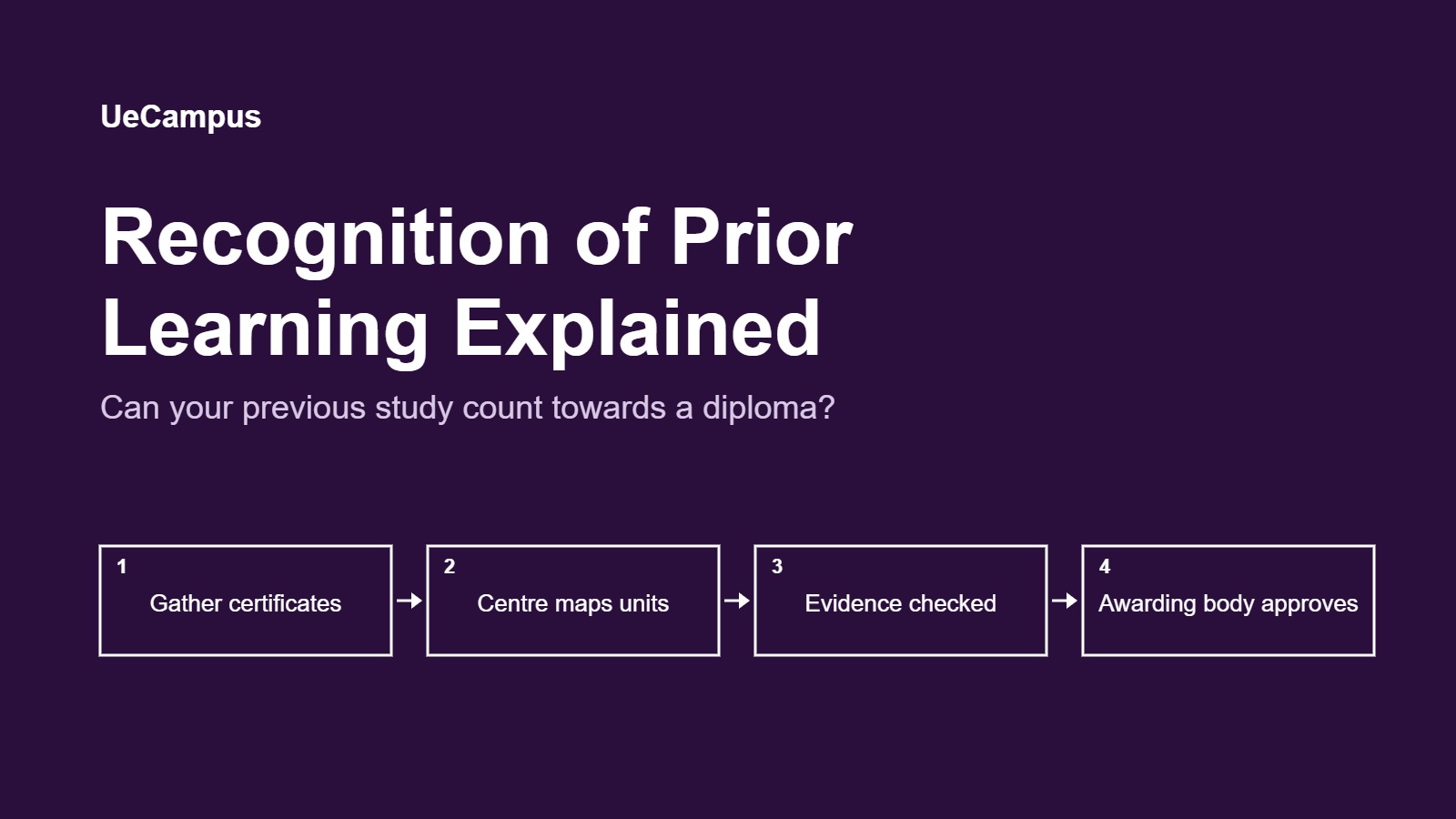
- Gather your documents. You will need the certificate or transcript for your earlier qualification, and ideally the unit list or learning outcomes.
- The centre maps your learning. Your study centre completes a mapping grid on your behalf, comparing the content of your earlier units with the units you want credit for.
- The evidence is checked. As with all learner evidence, RPL evidence must be valid, current, reliable, authentic and sufficient.
- The awarding body approves. Under Qualifi's policy, the External Quality Assurer should approve all exemptions.
- You study the remaining units. Any units that are not credited are completed and assessed in the normal way. Our guide on how online diplomas are assessed explains what that involves.
If you disagree with a decision about your claim, Qualifi's policy says you follow the centre's standard appeals process.
A simple example
Imagine someone who completed several business units at Level 4 with a regulated awarding body two years ago, and who now wants to study a Qualifi Level 4 business diploma.
- Their certificate and transcript are from a regulated awarding body, so the evidence is the right type.
- The study is within the last three years, so it is likely to be current.
- The centre would map each earlier unit against the Qualifi units. Only units with at least a 70% overlap could be put forward.
- Even if many units matched, no more than 70% of the qualification could be exempted.
Now compare someone with ten years of management experience but no certificated study. Under Qualifi's current policy, that experience would not normally be credited, although it may still help them meet the entry requirements.
Does RPL make the diploma worth less?
No. RPL is a recognised part of how regulated qualifications work. The credited units are backed by earlier certificated study, the centre's mapping is checked, and the awarding body's External Quality Assurer approves exemptions. The qualification you receive is the same qualification.
What about using your diploma towards a degree?
That is a different question. Moving from a diploma onto a university course is decided by the university, not by the awarding body. As our guide to how many credits a degree needs explains, credit transfer is not automatic, and each university decides which credits it will accept. If a degree is your goal, read what a top-up degree is and check the university's own entry rules.
Questions to ask before you enrol
- Does the qualification I am interested in allow RPL?
- Which of my earlier units might map to its units?
- What documents do you need from me, and by when?
- How long does a decision usually take?
- If some units are credited, how does that change my study plan?
Bringing your certificates and transcripts to the first conversation will make these answers much quicker.
Programmes to explore
If you already hold some certificated study, these programmes are a good place to start the conversation:
- Qualifi Level 4 Diploma in Business Management
- Qualifi Level 5 Diploma in Extended Business Management
- Level 7 Diploma in Strategic Management and Leadership
You can compare every option in the UeCampus programme catalogue. To understand where your earlier study sits, our guide to UK qualification levels is a helpful starting point, and what Qualifi is and how it is regulated gives more background on the awarding body.
Frequently asked questions
Can my work experience count towards a Qualifi diploma?
Not normally as credit. Qualifi's August 2025 RPL policy says it does not ordinarily apply credit for work-based knowledge or understanding. Work experience may still be considered when you apply, as part of the entry requirements.
How much of a qualification can I claim through RPL?
Under Qualifi's policy, a maximum of 70% of the units in a qualification can be exempted.
How old can my previous qualification be?
Qualifi's policy says prior learning must be current, which will normally be within the last three years.
Who decides whether my RPL claim is accepted?
Your centre maps your earlier learning against the new units, and Qualifi's External Quality Assurer should approve all exemptions.
Ready to find out what counts?
If you have earlier certificates or transcripts, the quickest way to find out what might count is to talk to us. Enquire now and the UeCampus admissions team will look at your background and explain your options for your chosen programme.
Thinking about studying online?
Explore accredited UeCampus programmes and UK diplomas, or speak to an admissions advisor about the next intake.
Browse programmes Enquire now