Can You Do an MBA Without a Bachelor's Degree? Three Routes That Actually Work
Yes, in some cases. Here is how admissions teams assess applicants without a first degree, the three realistic routes (experience-based entry, an Ofqual-regulated Level 7 diploma, and building up to a top-up degree), how long each takes and what evidence you will need.
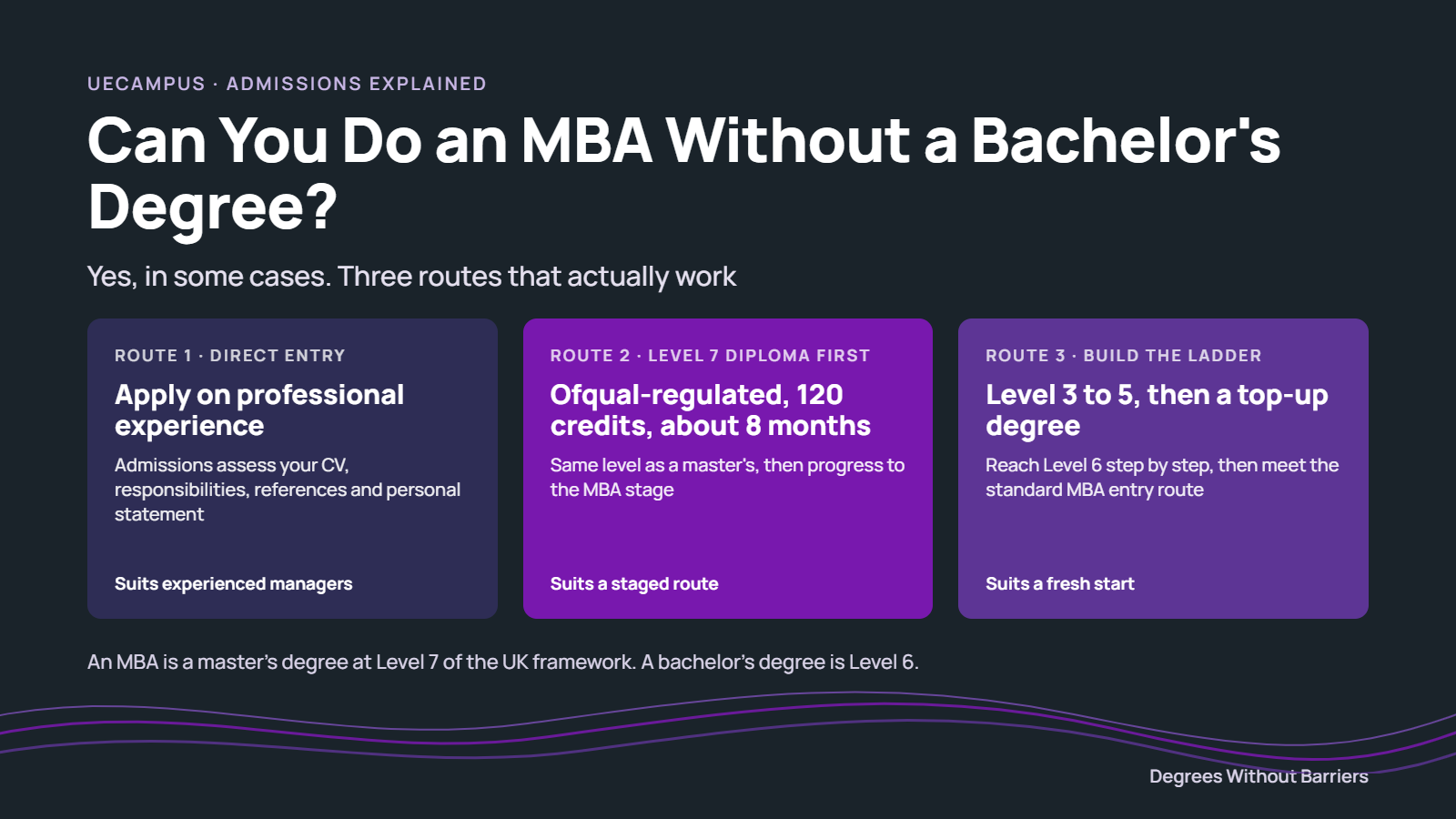
Yes, you can, but it is not automatic. In the UK framework an MBA is a master's degree, which sits at Level 7, one step above a bachelor's degree at Level 6. Most business schools therefore ask for a first degree as their standard entry route. The important word is standard. Admissions teams are allowed to look at what you have achieved at work instead, and there is a regulated qualification route that lets you prove yourself at Level 7 before you commit to a full MBA.
This guide explains how admissions teams actually assess applicants without a degree, the three realistic routes (direct entry on professional experience, a Level 7 diploma first, and building up from a lower level), how long each takes, and what evidence you will need. It is written for working adults who left formal education early, built a career, and now want the qualification to match.
The short answer
- A bachelor's degree is the normal entry requirement for an MBA, not an absolute one. The UK's Quality Assurance Agency (QAA) describes master's entrants as people with an honours degree or equivalent, or people who have gained experience through work that gives admissions staff confidence they can succeed.
- Many MBA programmes assess applications holistically: your years and level of responsibility, your achievements, references, a personal statement and your English proficiency.
- If you do not yet have enough experience, you can start with an Ofqual-regulated Level 7 diploma (the same level as a master's) and progress to the MBA afterwards.
- If you have neither a degree nor much experience, the ladder from Level 3 to Level 5, then a top-up degree, then an MBA is slower but open to almost everyone.
Why most MBAs ask for a bachelor's degree (and why some do not)
The UK government's list of qualification levels places a bachelor's degree with honours at Level 6 and a master's degree, a postgraduate diploma and a Level 7 diploma all at Level 7. A business school asking for a bachelor's degree is simply asking you to show that you have already studied at the level directly below.
The QAA's Master's Degree Characteristics Statement, the reference document UK universities use when they design master's programmes, adds two details that matter here. First, a UK master's degree normally carries a minimum of 180 credits, with at least 150 at master's level. Second, the statement lists the MBA as an example of a professional or practice master's degree, and it says plainly that these courses often attract entrants either with an honours degree or with experience, which may or may not be directly related to the profession.
So the door is open at the policy level. Each institution then sets its own entry rules. When a programme page says "bachelor's degree or equivalent professional experience", it is applying exactly this principle, and "equivalent" is judged by the admissions team: usually several years in a role with real responsibility (managing people, budgets, projects or a business of your own) and clear signs that you can read, write and reason at postgraduate level.
Route 1: Apply directly on your professional experience
This route suits experienced managers, business owners and senior professionals who have been running things for years but never completed a degree.
Some MBAs explicitly accept equivalent professional experience in place of a degree. At UeCampus, the Master of Business Administration (MBA) with eie European Business School lists "Bachelor's degree or equivalent professional experience" as its entry requirement, alongside a personal statement and English proficiency at IELTS 6.0 or equivalent. The programme is delivered 100% online and leads to a dual qualification: the MBA awarded by eie, a Malta-based higher education institution licensed by the Malta Further and Higher Education Authority (MFHEA) and aligned to Level 7 of the Malta and European Qualifications Frameworks, together with the Qualifi Level 7 Diploma in Strategic Management and Leadership, which is regulated by Ofqual in the UK.
Two honest caveats. "Considered" is not "guaranteed": expect to be asked for a detailed CV, evidence of your responsibilities, references and a personal statement, and the admissions team confirms your eligibility before any offer is made. And not every MBA offers this route. UeCampus's MBA International Business with PPA Business School Paris and MBA General Management with Walsh College, USA currently list a bachelor's degree as a standard entry requirement, so if one of those awards is your goal, Route 2 or Route 3 is the realistic path to it.
Route 2: Take a Level 7 diploma first, then progress to the MBA
This route suits people with solid work experience who want to prove themselves at postgraduate level before committing to a full MBA, who want to spread the cost, or who value a regulated UK qualification in its own right.
A Level 7 diploma sits at the same level as a master's degree on the UK framework but is smaller. The Qualifi Level 7 Diploma in Strategic Management and Leadership offered through UeCampus is an Ofqual-regulated qualification (qualification number 601/5335/0) worth 120 credits. It is studied 100% online over around eight months, with assignment-based assessment and no exams. Its standard entry requirements are a bachelor's degree or a Level 6 qualification, with relevant professional experience considered for mature applicants, plus English at IELTS 6.0 or equivalent. That second line is the one that matters if you do not have a degree.
Because a full master's degree typically carries 180 credits, the diploma does not make you an MBA graduate on its own. What it gives you is 120 recognised credits at Level 7 that are designed for progression: the awarding body's stated progression route is a dissertation stage to complete a master's degree with a university. Our guide to what a Level 7 diploma is and how it leads to a master's explains how universities assess those credits. At UeCampus, the eie MBA described above builds the same Qualifi diploma into its structure as a dual award, so if you complete the diploma first and later decide you want the MBA, ask the admissions team how your existing credits are treated before you apply.
Route 3: Build the ladder from Level 3, 4 or 5, then top up
This route suits people with little formal education and limited management experience, including younger career-changers. It is the longest route, but every step is a recognised qualification in its own right, and you can stop at any rung with something to show for it.
Regulated diplomas at Levels 3, 4 and 5 map to UK school-leaver, first-year undergraduate and second-year undergraduate levels respectively. For example, the Qualifi Level 5 Extended Diploma in Business Management at UeCampus asks for a Level 4 qualification or equivalent, considers mature applicants with relevant work experience, requires English at IELTS 5.5 or equivalent, and takes around eight months online. After Level 5, a top-up degree completes the bachelor's at Level 6, and from there you meet the standard MBA entry route like any other graduate. If you are weighing up where to start, our explainer on what a Level 5 diploma is covers the entry points at each level.
The three routes compared
| Route | Best for | Time before you hold the MBA | What you need to start | What you get |
|---|---|---|---|---|
| 1. Direct entry on experience | Managers, business owners and senior professionals | About 10 to 18 months for the eie MBA, depending on pace and intake (check the programme page for the current intake) | Substantial professional experience, a personal statement and English at IELTS 6.0 or equivalent | MBA plus the Qualifi Level 7 Diploma as a dual award |
| 2. Level 7 diploma, then MBA | Experienced professionals who prefer a staged route | Around 8 months for the diploma, then the MBA stage | A degree or Level 6 qualification, or relevant professional experience as a mature applicant | An Ofqual-regulated Level 7 diploma (120 credits) first, then the MBA |
| 3. Level 3 to 5, top-up, then MBA | People with little formal education or management experience | Several years in total | Entry at whichever level matches your current background | A bachelor's degree on the way, then the MBA |
What admissions teams look for when you do not have a degree
Admissions advisors cannot see a transcript, so they look for other evidence that you can cope with postgraduate study. Prepare the following before you apply:
- Years and seniority. How long you have worked, and at what level of responsibility. Managing a team, a budget, a client portfolio or your own company all count for more than job titles.
- Evidence of achievement. Projects delivered, targets met, problems solved. Put numbers on them where you can.
- Professional qualifications and short courses. Accountancy, HR, project management or industry certificates show that you can study and pass assessments as an adult.
- References. A manager, client or professional contact who can confirm what you did.
- A personal statement. Why an MBA, why now, and what you will bring to the classroom. This is the document admissions staff read most closely.
- English proficiency. IELTS 6.0 or equivalent is the usual benchmark for the Level 7 and MBA routes above.
Two practical tips. Be specific and honest rather than impressive; admissions teams check. And ask early: a short conversation with an advisor will tell you which route you qualify for today, which saves you from applying for the wrong one.
Red flags: "MBAs" that are not worth having
Because so many people search for an MBA without a degree, there is a market in awards that look like MBAs but are not. Walk away from any of the following:
- Degrees awarded for "life experience" alone, with no assessed work, no tutors and no time commitment.
- Providers that cannot tell you who regulates or licenses the institution that awards the qualification. UK regulated qualifications such as Qualifi diplomas can be checked on the Ofqual register; universities and colleges should be able to point you to their national regulator or recognised accreditor.
- Guaranteed acceptance, or a fixed and very short completion time with no assessment.
UeCampus lists the awarding bodies and partner institutions behind its programmes on its accreditation and partners page. If you want a longer explanation of how recognition works for online study, read our article on whether online degrees are actually recognised.
MBA and Level 7 routes available at UeCampus
- Master of Business Administration (MBA), eie European Business School: online dual award with the Qualifi Level 7 Diploma; entry on a bachelor's degree or equivalent professional experience.
- Qualifi Level 7 Diploma in Strategic Management and Leadership: Ofqual-regulated, 120 credits, around eight months online; relevant professional experience considered for mature applicants.
- MBA International Business, PPA Business School Paris: French MBA plus the Qualifi Level 7 Diploma; a bachelor's degree is a standard entry requirement.
- MBA General Management, Walsh College, USA: US degree from an institution accredited by the Higher Learning Commission; a bachelor's degree is a standard entry requirement.
- Subject-specific Level 7 diplomas in Accounting and Finance, Human Resource Management and Strategic Marketing for people who want postgraduate credit in a specialism rather than general management.
Current fees and payment plans are listed on the tuition and fees page, and the scholarships page explains the funding support available to online students.
Frequently asked questions
Is a Level 7 diploma the same as an MBA?
No. Both sit at Level 7, but a Level 7 diploma is typically 120 credits and a master's degree is typically 180. The diploma is a recognised qualification in its own right and is designed to lead on to a master's or MBA, usually through a dissertation or final stage.
How many years of experience do I need to be accepted without a degree?
There is no single number, and UeCampus assesses each application holistically. As a guide, the MBAs that do require a degree also prefer at least two years of professional experience, so an applicant relying on experience alone should expect to show considerably more responsibility than that, ideally in management or running a business.
Can I get onto an MBA with a Level 5 diploma?
Not directly in most cases. Level 5 is second-year undergraduate level. The usual path is a top-up degree to complete the bachelor's first, or, if you also have substantial management experience, an application on the strength of that experience.
Will my MBA be worth less because I got in without a bachelor's degree?
No. The award you graduate with is the same MBA as everyone else's. What employers and other universities look at is the institution that awarded it and the regulator or accreditor behind it, not how you met the entry requirements.
Do I need a GMAT or GRE score?
The UeCampus MBA and Level 7 programme pages linked in this article do not list GMAT or GRE among their entry requirements. They ask for academic or professional evidence, a personal statement and proof of English proficiency.
Can I do a master's that is not an MBA without a bachelor's degree?
The same principle applies, but it is used less often. Specialist master's degrees usually expect a background in the subject, whereas professional master's degrees such as the MBA are more open to applicants whose experience comes from work. If your aim is a specialist field, a Level 7 diploma in that subject is often the most realistic first step.
Next steps
If you are not sure which route you qualify for, the quickest way to find out is to talk to the UeCampus admissions team. There is no fee to apply, and an advisor will look at your experience and tell you honestly whether direct entry, the Level 7 diploma or an earlier starting point is the right first move. You can also browse all UeCampus programmes to compare the MBA and diploma options side by side.
If you are still deciding whether an MBA is the right goal, our comparison of online and traditional MBAs and our guide to studying for a degree at 30, 40 and beyond are good places to continue.
Thinking about studying online?
Explore accredited UeCampus programmes and UK diplomas, or speak to an admissions advisor about the next intake.
Browse programmes Enquire now