What Is a Level 5 Diploma? Is It Equivalent to a Degree, and Can It Lead to a Top-Up?
A Level 5 diploma sits at the second year of a UK bachelor's degree. Here is how it compares with an HND and a foundation degree, what 240 credits actually mean, and how it can lead to a top-up degree.

A Level 5 diploma is a UK higher-education qualification that sits at the same level as the second year of a bachelor's degree. It is not a degree in itself, but it is a recognised stepping stone towards one: many Level 5 diplomas are designed so that you can move on to the final year of a bachelor's programme, often called a "top-up". For working adults who want a structured, affordable way to reach degree level without starting from scratch, a Level 5 diploma is one of the most practical routes available.
This guide explains what "Level 5" means, how a Level 5 diploma compares with an HND, a foundation degree and a full degree, what the credits look like in practice, who it suits, and how it can lead to a top-up degree.
What "Level 5" actually means
In England, Wales and Northern Ireland, qualifications are placed on a national framework that runs from Entry Level up to Level 8 (doctorate). The official list of qualification levels published by the UK government places the following at Level 5:
- Level 5 diploma, certificate and award
- Higher National Diploma (HND)
- Foundation degree
- Diploma of Higher Education (DipHE)
- Level 5 NVQ
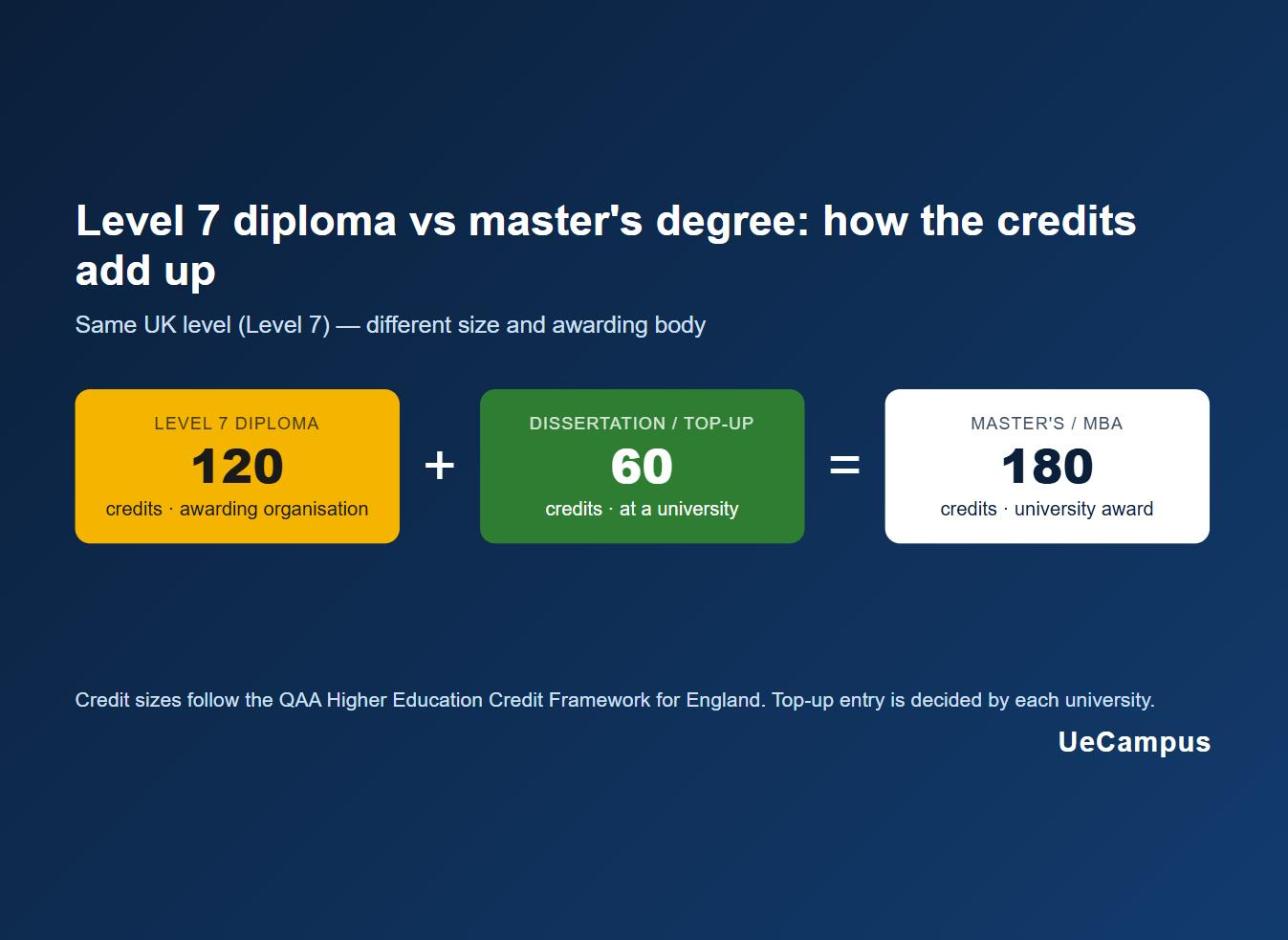
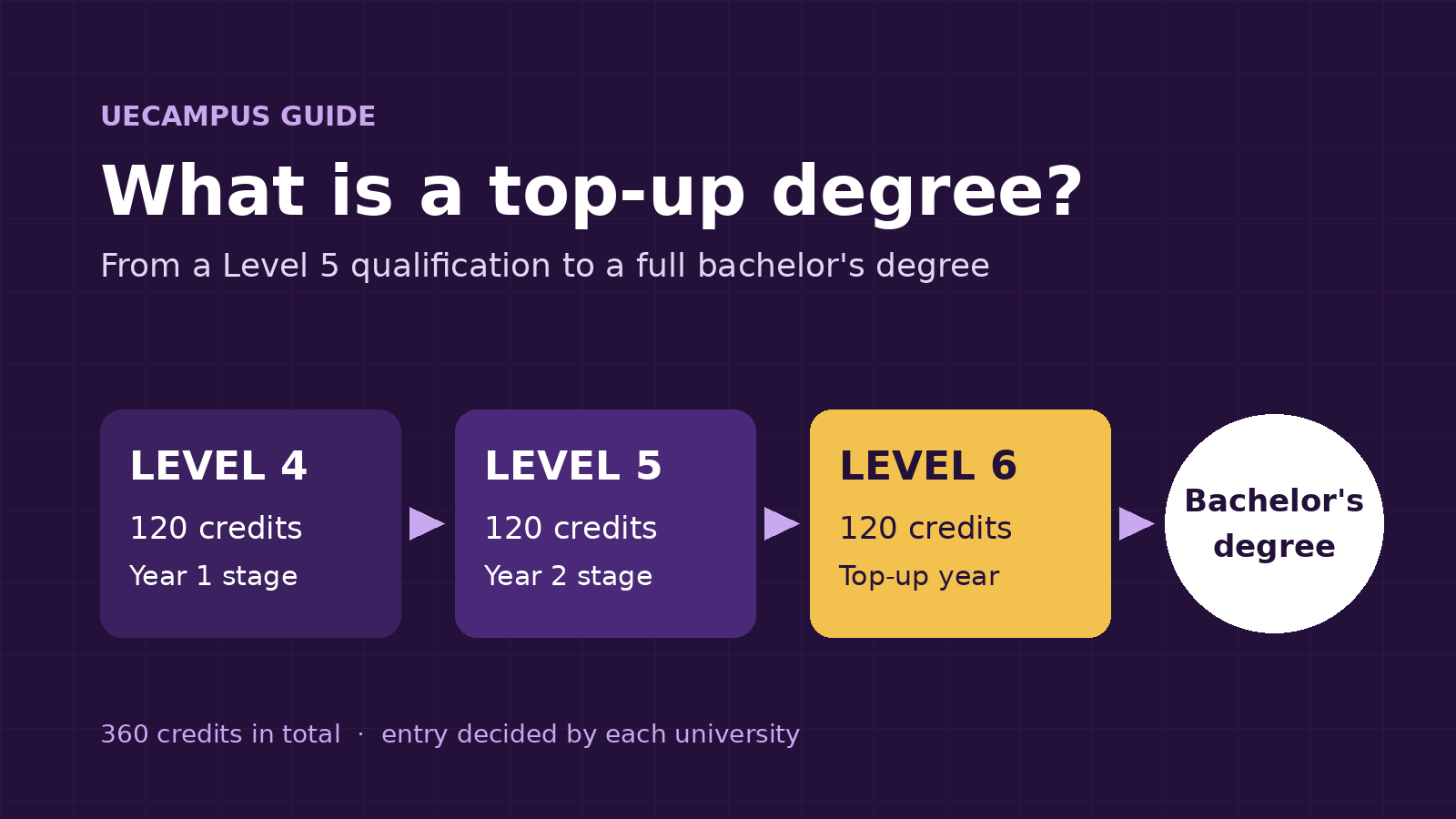
In plain terms, Level 5 is the level you reach after the second year of a three-year bachelor's degree. Level 4 corresponds to the first year, Level 5 to the second year and Level 6 to the final, honours year. Level 7 is master's level, which we cover separately in our guide to what a Level 7 diploma is.
So a Level 5 diploma is "undergraduate level", but it is a smaller or shorter qualification than a full bachelor's degree. The level tells you the difficulty and depth of the learning; the credit value tells you the size.
Level 5 diploma vs HND vs foundation degree vs DipHE
Because several very different-sounding qualifications all sit at Level 5, it helps to know how they compare.
| Qualification | Level | Typical size | Who awards it | Typical next step |
|---|---|---|---|---|
| Level 5 diploma (standard) | 5 | 120 credits at Level 5 | Ofqual-regulated awarding organisation (for example Qualifi) | Level 6 top-up, or employment |
| Level 5 Extended diploma | 4 + 5 | 240 credits (120 at Level 4, 120 at Level 5) | Ofqual-regulated awarding organisation | Final year of a bachelor's (top-up) |
| Higher National Diploma (HND) | 5 | 240 credits | Awarded under licence from Pearson | Final year of a bachelor's (top-up) |
| Foundation degree (FdA/FdSc) | 5 | 240 credits | A university or college with degree-awarding powers | Final year of a bachelor's (top-up) |
| Diploma of Higher Education (DipHE) | 5 | 240 credits | A university | Final year of a bachelor's, or employment |
The credit values for the HND, foundation degree and DipHE come from the Higher Education Credit Framework for England, which uses 120 credits as the typical volume for one academic year of full-time study. That is why a 240-credit Level 5 qualification is usually described as "the first two years of a degree".
The practical difference is who awards it and how it is assessed. A university awards a foundation degree or DipHE. A regulated awarding organisation such as Qualifi awards a Level 5 diploma, usually through coursework and a portfolio of evidence rather than exams. That assessment style is one reason online Level 5 diplomas are popular with people who are already working.
Standard vs Extended Level 5 diplomas: a worked example
The word "Extended" matters. A standard Level 5 diploma usually contains 120 credits at Level 5 only, and assumes you already hold a Level 4 qualification. An Extended Level 5 diploma bundles the Level 4 and Level 5 stages together into one 240-credit programme.
Take the Qualifi Level 5 Extended Diploma in Business Management that UeCampus delivers online. On the Ofqual Register of Regulated Qualifications it is listed as qualification number 610/1675/5, with 240 total credits, 2,400 hours of total qualification time, 960 guided learning hours, and assessment by coursework and a portfolio of evidence graded Pass, Merit or Distinction. It is available to learners in England and internationally.
Its twelve units cover the ground you would expect in the first two years of a business degree: communications in organisations, leadership and the organisation, financial awareness, managing change, business operations, developing teams, responding to the changing business environment, effective decision making, business development, business models and growing organisations, customer management, and risk management and organisations.
Because the programme already includes the Level 4 stage, you do not need a separate Qualifi Level 4 Diploma in Business Management first. If you already hold a Level 4 diploma, a standard Level 5 diploma may be the better fit, and our admissions team can help you check which route matches your existing qualifications.
Is a Level 5 diploma equivalent to a degree?
No. A Level 5 diploma is equivalent to the second year of a bachelor's degree, not the whole degree. A bachelor's degree with honours is a Level 6 qualification with a minimum of 360 credits, so after a 240-credit Level 5 qualification you still have the final 120 credits to complete.
That is exactly what a top-up degree is for. A top-up lets you enter the final year of a bachelor's programme on the strength of a relevant Level 5 qualification, so you finish with a full honours degree rather than a diploma. We explain the mechanics, the typical entry conditions and the common pitfalls in our guide to what a top-up degree is.
Two caveats are worth stating plainly:
- Progression to a top-up is never automatic. Each university or college sets its own entry requirements, may ask for a particular grade profile, subject match or English-language evidence, and makes the final admission decision.
- A Level 5 diploma on its own is still a meaningful qualification. The awarding organisation for the Qualifi example above lists progression to the final year of a UK honours degree as the intended route, but many learners use a Level 5 diploma directly for promotion, a career change or as evidence of management-level study.
If you are weighing a diploma against going straight into a degree, our comparison of an online diploma vs degree sets out the trade-offs.
Who a Level 5 diploma suits
A Level 5 diploma tends to be the right choice when one or more of the following applies:
- You left education after A-levels, a Level 3 diploma or equivalent, and want to reach degree level in stages rather than committing to three years at once.
- You have management or professional experience but no formal higher-education qualification, and want a credential that reflects what you already do.
- You hold a degree in a different field and want a structured route into business, IT, cyber security or psychology without repeating a full undergraduate programme.
- You need to keep working while you study. Online, coursework-assessed delivery with no fixed exam dates fits around shifts, travel and family.
For the Qualifi Level 5 Extended Diploma in Business Management, the awarding organisation's published entry profile is learners with qualifications at Level 3 and/or Level 4, learners with managerial work experience and clear career goals, or learners with a first degree in another discipline. UeCampus confirms eligibility individually, so if your background does not fit neatly into one of those lines it is still worth asking.
It is less suitable if you already hold a Level 5 or higher qualification in the same subject, in which case a Level 6 top-up or a Level 7 diploma is usually the more efficient next step.
How long does a Level 5 diploma take?
Total qualification time is the regulator's estimate of the hours a typical learner needs, including guided learning and independent study. For the Qualifi Level 5 Extended Diploma in Business Management that figure is 2,400 hours. How quickly you get through it depends on the delivery model and how many hours a week you can commit.
UeCampus delivers its Level 5 diplomas fully online with flexible pacing, one-to-one tutor support and an assessment-based structure rather than exams. The indicative duration shown on each programme page is a guide, and the admissions team can map a realistic timeline to your weekly availability before you enrol.
Is a Level 5 diploma recognised?
A Level 5 diploma from an Ofqual-regulated awarding organisation appears on the public Register of Regulated Qualifications, which is what employers, universities and credential evaluators use to check that a UK qualification is genuine and to see its level and size. Qualifi is one such regulated awarding organisation; you can read more about the partnership on the UeCampus Qualifi partner page.
Recognition for a specific purpose, such as entry to a particular university, a visa application or a professional body, always depends on that organisation's own rules. If you have a specific destination in mind, check its requirements before you enrol, and tell our admissions team so they can advise on the most suitable route. Our article on whether online degrees are actually recognised covers how to make that check.
Level 5 diploma subjects you can study online with UeCampus
UeCampus offers Ofqual-regulated Qualifi Level 5 diplomas in the following subjects, all delivered online:
- Qualifi Level 5 Extended Diploma in Business Management
- Qualifi Level 5 Diploma in Information Technology
- Qualifi Level 5 Diploma in Cyber Security
- Qualifi Level 5 Diploma in Psychology
- Qualifi Level 5 Diploma in Hospitality and Tourism
- Qualifi Level 5 Diploma in Accounting and Finance
- Level 5 Diploma in Artificial Intelligence
If you are starting from a Level 3 background, the Qualifi Level 4 Diploma in Business Management and other Level 4 diplomas in the UeCampus programme catalogue are the usual first stage. Current tuition and payment plans are listed on the fees page, and the scholarship page explains the support available.
Frequently asked questions
Is a Level 5 diploma the same as an HND?
They sit at the same level and a 240-credit Level 5 Extended diploma is the same size as an HND, but they are different qualifications from different awarding routes. An HND is awarded under licence from Pearson, while a Level 5 diploma is awarded by an Ofqual-regulated awarding organisation such as Qualifi. Both are commonly used for entry to a final-year top-up.
Is Level 5 higher than A-levels?
Yes. A-levels are Level 3. Level 4 is the first year of higher education and Level 5 is the second year, so a Level 5 diploma is two levels above A-levels.
Can I get a job with a Level 5 diploma?
A Level 5 diploma is a recognised undergraduate-level qualification and is used for supervisory, junior management and specialist roles, as well as for promotion within a current employer. Outcomes depend on your field, experience and the employer, so treat the diploma as evidence of capability rather than a guarantee of a particular job.
Do I need a Level 4 diploma before a Level 5 diploma?
For a standard 120-credit Level 5 diploma, usually yes. For an Extended Level 5 diploma, no, because the Level 4 stage is built into the programme. Relevant work experience or a degree in another field can also satisfy entry requirements, depending on the awarding organisation's rules.
Can a Level 5 diploma lead to a master's?
Not directly. A master's degree or Level 7 diploma normally requires a bachelor's degree or equivalent, so the usual path is Level 5 diploma, then a Level 6 top-up to complete the bachelor's, then postgraduate study. Some Level 7 diplomas accept substantial managerial experience in place of a degree; see our Level 7 diploma guide for details.
How is a Level 5 diploma assessed?
Qualifi Level 5 diplomas are assessed through coursework and a portfolio of evidence rather than timed exams, and graded Pass, Merit or Distinction. Assignments are typically based on real workplace scenarios, which is why the qualification works well for people who are already in employment.
Next steps
If you want to reach degree level in manageable stages, a Level 5 diploma is a sensible place to start. Explore the Level 5 programmes above, or browse the full UeCampus programme catalogue to compare Level 4, Level 5 and top-up options side by side.
Not sure which level matches your background? Enquire now and the UeCampus admissions team will confirm your eligibility, explain the top-up route and plan an intake that fits your schedule. You can also check our frequently asked questions for quick answers on fees, study time and support.
Thinking about studying online?
Explore accredited UeCampus programmes and UK diplomas, or speak to an admissions advisor about the next intake.
Browse programmes Enquire now