What Is a Level 7 Diploma? Is It Equivalent to a Master's, and Can It Lead to an MBA?
A Level 7 diploma sits at master's level in the UK framework but is smaller than a master's degree. Here is how the credits compare, who it suits, and how it can lead to an MBA or master's.
A Level 7 diploma is a postgraduate-level qualification that sits at the same level as a master’s degree in the UK framework, but it is not the same thing as a master’s degree. It is usually smaller (120 credits rather than 180), it is awarded by a regulated awarding organisation rather than a university, and it is assessed through work-based assignments instead of a dissertation. For many working professionals, that combination makes it a faster and more affordable way to reach master’s level, and a recognised stepping stone towards a full MBA or MSc. This guide explains what the level means, how the credits compare, who it suits, and what to check before you enrol.
What “Level 7” actually means
In England, Northern Ireland and Wales, qualifications are organised on a ladder of levels from Entry Level up to Level 8. The UK government’s list of qualification levels places the following at Level 7:
- master’s degrees (MA, MSc, MBA)
- integrated master’s degrees such as MEng
- postgraduate diplomas and postgraduate certificates
- the PGCE teaching qualification
- Level 7 diplomas, certificates and awards
- Level 7 NVQs
So when a course is described as “Level 7”, it means the learning has been judged to sit at postgraduate level: the same intellectual demand as master’s study. A Level 6 qualification is bachelor’s level; Level 8 is doctoral level.
The important word is level, not equivalent. Two qualifications at the same level are pitched at the same standard of difficulty, but they can differ in size, in who awards them, and in what they are designed to do.
Level 7 diploma vs master’s degree: the differences that matter
The clearest way to understand the gap is to look at credits. In UK higher education, one credit represents about ten hours of notional learning, and the QAA’s Higher Education Credit Framework for England sets out the typical sizes of postgraduate qualifications.
| Qualification | Typical minimum credits | Credits at Level 7 | Awarded by |
|---|---|---|---|
| Postgraduate certificate | 60 | at least 40 | University |
| Postgraduate diploma | 120 | at least 90 | University |
| Level 7 diploma (regulated) | commonly 120 | 120 | Ofqual-regulated awarding organisation |
| Taught master’s degree (MA, MSc, MBA) | 180 | at least 150 | University |
Reading across that table tells you three things:
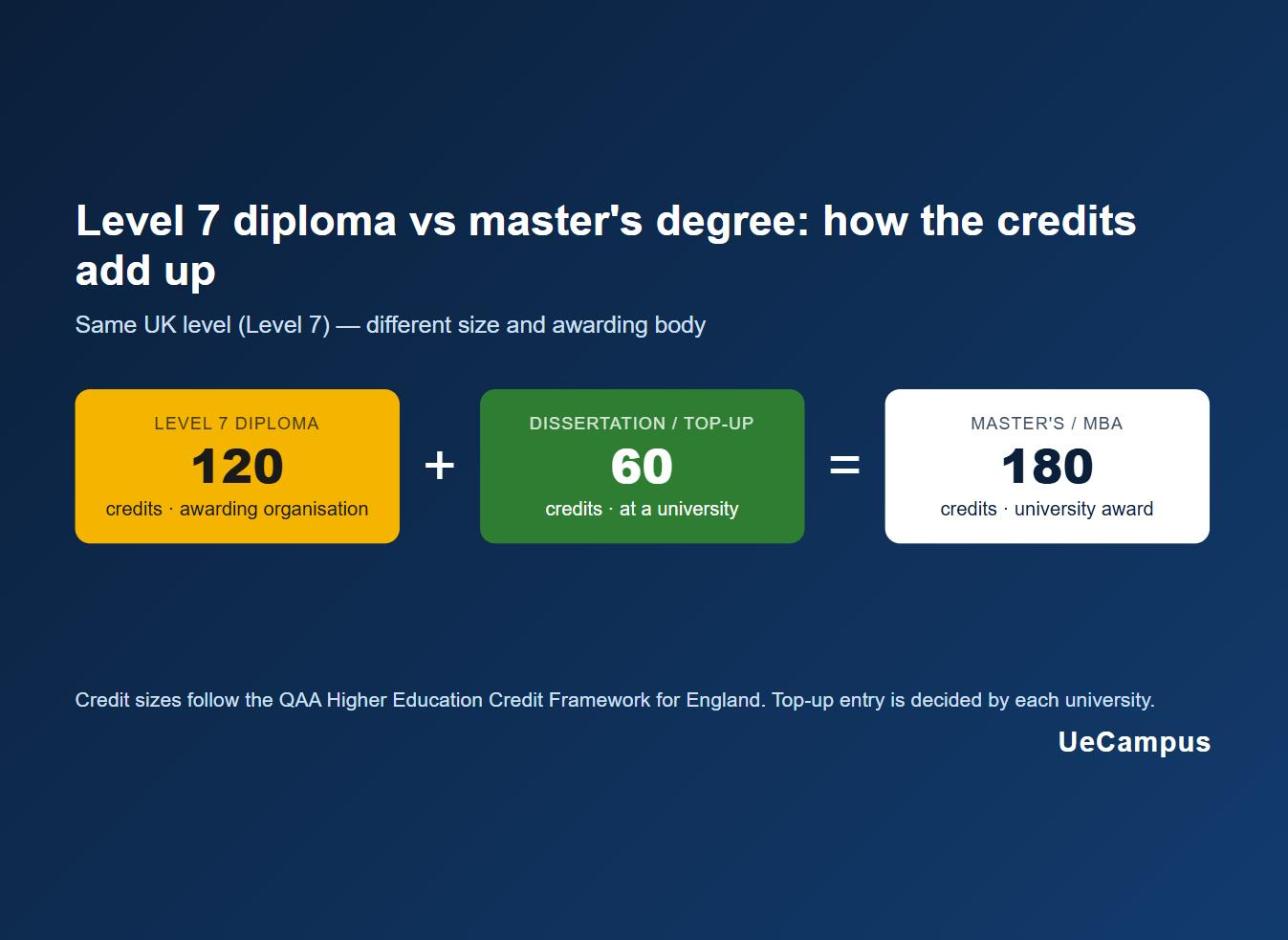
- A 120-credit Level 7 diploma is about two-thirds the size of a master’s. The remaining 60 credits in a master’s degree are normally the dissertation or final research project.
- It is the same size as a university postgraduate diploma. That is why many universities will consider a Level 7 diploma for entry to the final stage of a master’s.
- The awarding body is different. A master’s is awarded by a university with degree-awarding powers. A Level 7 diploma is awarded by an awarding organisation that is regulated by Ofqual, the qualifications regulator in England.
There are other practical differences. Level 7 diplomas are usually assessed by assignments linked to real workplace problems rather than examinations or a dissertation, which suits managers who want to apply what they learn immediately. They are generally shorter and lower in cost than a full master’s. The trade-off is that you finish with a diploma, not a degree title, and you cannot call yourself a master’s graduate on the strength of the diploma alone.
If you want to see how this compares at bachelor’s level, our guide to online diplomas versus degrees walks through the same logic for undergraduate study.
Example: the Qualifi Level 7 Diploma in Strategic Management and Leadership
A concrete example makes the numbers easier to follow. The Level 7 Diploma in Strategic Management and Leadership offered online through UeCampus is awarded by Qualifi, a UK awarding organisation regulated by Ofqual.
On the Ofqual Register of Regulated Qualifications the qualification (number 601/5335/0) is listed at Level 7 with 120 credits, a total qualification time of 1,200 hours, assignment-based assessment and a Pass/Merit/Distinction grading scale. Its status on the register at the time of writing is “available to learners”.
The programme is built from six mandatory units of 15 credits each, covering strategic direction, strategic planning, information management and decision-making, leading a strategic project, managing team performance and your own development as a strategic manager, plus optional units to reach 120 credits. UeCampus delivers it fully online with assignment-based assessment and no traditional exams, and a typical completion time of around eight months of part-time study.
In its own specification, Qualifi describes the intended progression in two ways: learners can join a partner university to complete a dissertation and receive a full master’s degree, or move on to the Level 8 diploma. On the UeCampus side, that next step is the Qualifi Level 8 Diploma in Strategic Management and Leadership.
How a Level 7 diploma can lead to an MBA or master’s
This is the question most people really want answered, so it is worth being precise.
A Level 7 diploma does not automatically become a master’s degree. What it does is give you 120 credits of recognised postgraduate-level learning. Universities that run “top-up” or “advanced entry” master’s routes may accept those credits in place of the taught stage of their own programme, so that you only complete the final element, usually a dissertation or a capstone project, to graduate with the full master’s or MBA.
Whether a particular university will do this depends on its own admission rules. Universities normally look at:
- whether the diploma is regulated and at the right level (an Ofqual-regulated Level 7 diploma meets this test)
- how closely the diploma’s units match the content of their master’s programme
- how recently you completed it, and sometimes your grades
- your work experience and English language level
Because of this, you should treat “MBA top-up” as a route that needs confirming case by case, not as a guarantee attached to the diploma. The same caution applies at bachelor’s level, as explained in our guide to what a top-up degree is.
The alternative is to use the diploma as evidence of postgraduate readiness and apply for a full master’s directly. UeCampus delivers several online MBAs through its university partners, including the Online MBA in General Management from Walsh College, the Online MBA in International Business from PPA Business School Paris and the MBA from eie European Business School in Malta. Each has its own entry requirements, and admissions can tell you how a Level 7 diploma would be considered for the programme you have in mind.
Who a Level 7 diploma suits (and who should go straight to a master’s)
A Level 7 diploma tends to be the better first step if you:
- are already working in a management or specialist role and want a recognised postgraduate credential without pausing your career
- would rather be assessed on practical, work-based assignments than exams and a dissertation
- want to reach master’s level in stages, with a lower upfront cost and the option to top up later
- hold a bachelor’s degree or Level 6 qualification, or have substantial professional experience that an awarding body will consider in place of a degree
A full master’s degree is usually the better choice if you:
- need the degree title itself for a specific employer, licence or visa requirement
- are planning to progress to a doctorate, where a master’s is often expected
- want research training and the experience of writing a dissertation
- can commit the time and budget for 180 credits in one go
Many people combine the two: diploma first, master’s later. If you are weighing up an MBA specifically, our comparison of online and traditional MBAs covers the format question in more depth.
Is a Level 7 diploma recognised by employers?
Regulated Level 7 diplomas are listed on the Ofqual register, so an employer can check the level, size and awarding organisation of your qualification in a few minutes. In the UK, the Level 7 label itself tells employers that the study was at postgraduate standard.
Outside the UK, recognition works differently. Some employers and institutions understand UK levels well; others will ask for the qualification to be compared against their own national framework. Before you enrol, it is sensible to check how a UK Level 7 diploma is viewed in the country where you plan to use it, and whether the specific programme is listed on the regulator’s register. Our article on whether online qualifications are recognised explains what accreditation and regulation do and do not promise.
Level 7 diploma subjects you can study online with UeCampus
UeCampus offers a range of Level 7 diplomas, all delivered fully online with tutor support:
- Level 7 Diploma in Strategic Management and Leadership
- Level 7 Diploma in Accounting and Finance
- Level 7 Diploma in Human Resource Management
- Level 7 Diploma in Strategic Marketing
- Level 7 Diploma in Information Technology
- Level 7 Diploma in Data Science
- Level 7 Diploma in Education Management and Leadership
- Level 7 Diploma in Hospitality and Tourism Management
- Level 7 Diploma in Psychology
Each programme page lists its awarding body, units, entry requirements and payment options. You can also browse the full programme directory, check tuition and fees and see whether you qualify for a scholarship.
Frequently asked questions
Is a Level 7 diploma the same as a master’s degree?
No. Both sit at Level 7 of the UK framework, so they are pitched at the same academic standard, but a master’s degree is normally 180 credits and is awarded by a university, while a Level 7 diploma is commonly 120 credits and is awarded by an Ofqual-regulated awarding organisation. The diploma is comparable in size to a university postgraduate diploma.
Can I do a Level 7 diploma without a bachelor’s degree?
Often, yes. Awarding bodies typically ask for a bachelor’s degree or a Level 6 qualification, but they usually allow applicants with substantial relevant management experience to be considered instead. Each programme sets its own rules, so check the entry requirements on the programme page or ask admissions.
How long does a Level 7 diploma take?
A 120-credit diploma represents around 1,200 hours of total qualification time. Studied part-time online, programmes such as the UeCampus Level 7 Diploma in Strategic Management and Leadership are designed to be completed in roughly eight months, although your own pace will depend on how many hours a week you can commit.
Does a Level 7 diploma guarantee entry to an MBA top-up?
No qualification guarantees admission. A regulated Level 7 diploma is widely used as a route into the final stage of a master’s or MBA, but each university decides whether and how to recognise your credits. Confirm the route with the receiving institution before you rely on it.
What is the difference between a Level 7 diploma and a postgraduate diploma?
Both are typically 120 credits at Level 7. A postgraduate diploma (PGDip) is awarded by a university, usually as a stage of or exit award from a master’s programme. A Level 7 diploma is awarded by a regulated awarding organisation and is designed as a stand-alone professional qualification that can also be used for progression.
Is Level 7 higher than a degree?
Yes. A bachelor’s degree with honours is a Level 6 qualification. Level 7 is the next step up and is the level of master’s degrees and postgraduate diplomas.
Next steps
If you already hold a bachelor’s degree or have solid management experience and want a recognised postgraduate qualification you can complete alongside work, a Level 7 diploma is a practical starting point. Explore the Level 7 Diploma in Strategic Management and Leadership or compare the other Level 7 subjects above, and if you are not sure which route fits your goals, enquire now and the UeCampus admissions team will talk you through eligibility, intakes and what your diploma could lead to next.
Thinking about studying online?
Explore accredited UeCampus programmes and UK diplomas, or speak to an admissions advisor about the next intake.
Browse programmes Enquire now