How Many Credits Is a Degree? UK Credits, ECTS and US Credit Hours Explained
A UK honours degree is normally 360 credits and a taught master's is 180. See how UK credits convert to ECTS and US credit hours, and how the credits in your diploma can count towards a degree.
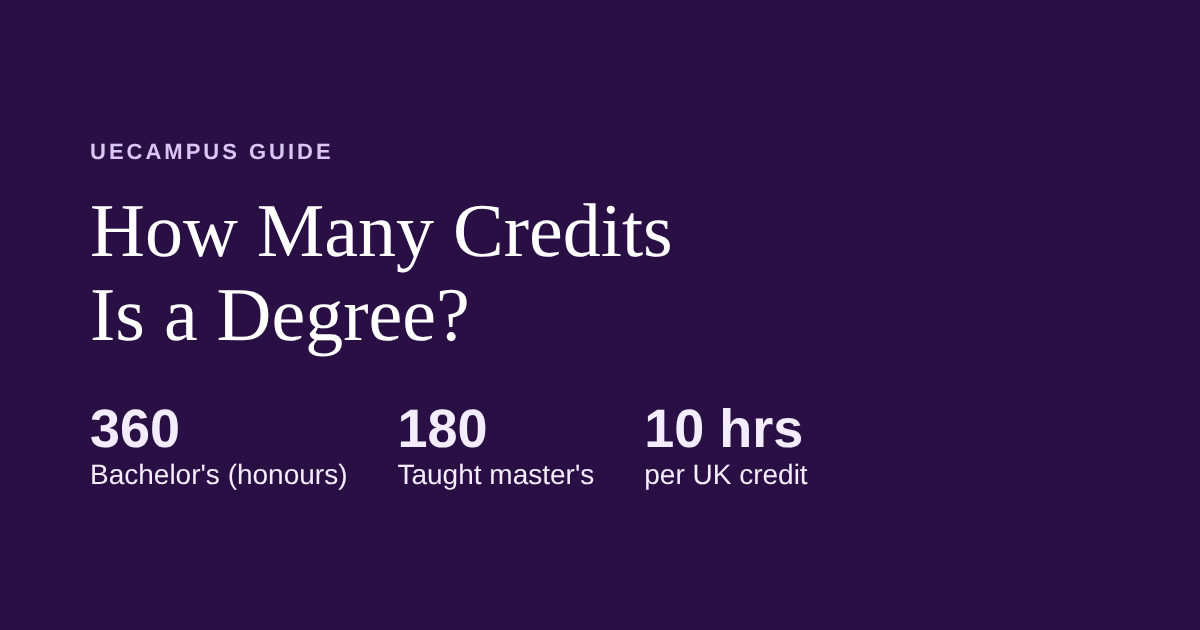
A UK bachelor's degree with honours is normally 360 credits, and a taught master's degree is normally 180 credits. One UK credit stands for about 10 hours of learning, so a 20-credit module is roughly 200 hours of work, including reading, assignments and revision. Those numbers matter more than most students realise, because credits are what universities look at when they decide whether a diploma you already hold can count towards a degree.
This guide explains how UK credits work, how they convert to European ECTS credits and US credit hours, and how to work out how many credits you already have.
What is a credit?
A credit is a way of measuring how much learning a course contains. In UK higher education, one credit is typically described as 10 notional learning hours. "Notional" means the time an average student is expected to need, counting everything: lessons, private study, assignments and assessment.
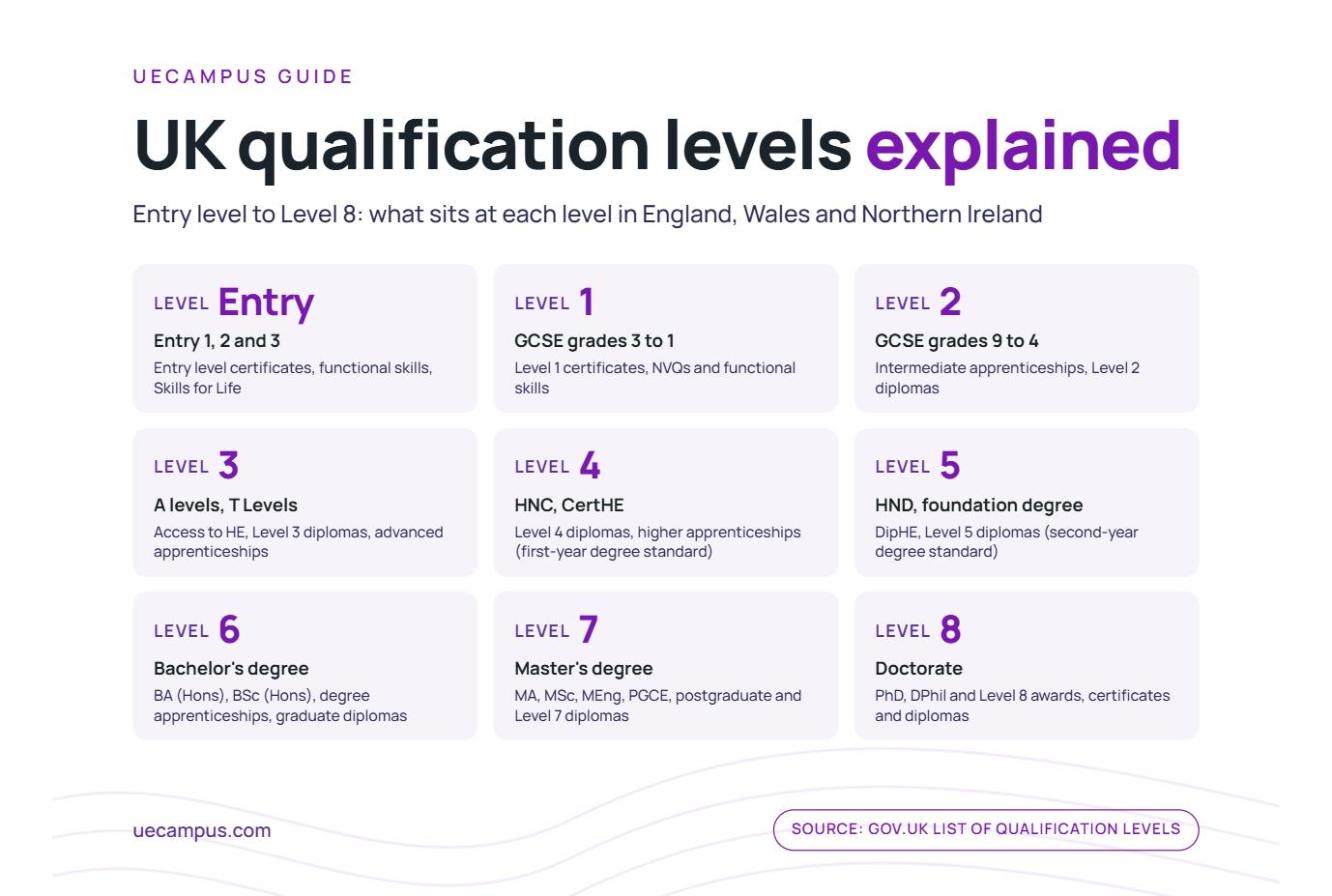
Every credit also sits at a level. A credit at Level 4 is first-year university standard, and a credit at Level 7 is master's standard. So a qualification is described by two things together: how many credits it has, and at what level. If the levels are new to you, our guide to UK qualification levels explains Levels 1 to 8 in plain English.
You will sometimes see the term CATS points. CATS stands for Credit Accumulation and Transfer Scheme. CATS points and UK credits are the same thing.
How many credits is each UK qualification?
The Quality Assurance Agency for Higher Education (QAA) publishes the Higher Education Credit Framework for England. It sets out the credit values typically attached to each university qualification.
| Qualification | Level | Typical total credits |
|---|---|---|
| Certificate of Higher Education (CertHE) or HNC | 4 | 120 |
| Diploma of Higher Education (DipHE), foundation degree or HND | 5 | 240 |
| Bachelor's degree (ordinary, without honours) | 6 | 300 |
| Bachelor's degree with honours | 6 | 360 |
| Postgraduate certificate | 7 | 60 |
| Postgraduate diploma | 7 | 120 |
| Taught master's degree (MA, MSc, MBA) | 7 | 180 |
| Integrated master's degree (MEng and similar) | 7 | 480 |
| Professional doctorate (DBA, EdD and similar) | 8 | 540 |
A PhD is not usually given a credit value, because it is judged on original research rather than on taught modules.
A full-time undergraduate year is normally built around 120 credits. That is why a three-year honours degree adds up to 360: 120 credits at Level 4, 120 at Level 5 and 120 at Level 6.
Where do Level 4, 5 and 7 diplomas fit?
Regulated diplomas from awarding organisations use the same credit and level language as universities. That is what makes them useful as stepping stones.
- The Qualifi Level 4 Diploma in Business Management is 120 credits at Level 4, the same size and level as the first year of a bachelor's degree. Our guide to what a Level 4 diploma is covers it in detail.
- The Qualifi Level 5 Extended Diploma in Business Management is 240 credits across Levels 4 and 5, the same size as the first two years of a degree. See what a Level 5 diploma is for more.
- The Level 7 Diploma in Strategic Management and Leadership is 120 credits at Level 7, the same size as a postgraduate diploma. Read what a Level 7 diploma is to see how it compares with a master's.
Here is the simple sum behind a top-up. An honours degree needs 360 credits. A Level 5 extended diploma gives you 240. The missing 120 credits at Level 6 are the final year, and that final year is what a top-up degree provides. The same logic applies at master's level: a 120-credit Level 7 diploma leaves about 60 credits, usually a dissertation or final project, to reach 180.
One important point: having the right number of credits does not force a university to accept them. The QAA framework is clear that credit transfer is not automatic. Each university decides which credits it will accept, so always confirm with the university you want to join before you rely on a progression route.
UK credits vs ECTS credits
Most of Europe uses the European Credit Transfer and Accumulation System (ECTS). The conversion is easy: in everyday practice, two UK credits equal one ECTS credit. A full-time year is 60 ECTS credits, which matches 120 UK credits.
| UK credits | ECTS credits | What it usually represents |
|---|---|---|
| 20 | 10 | One typical module |
| 120 | 60 | One full-time undergraduate year |
| 240 | 120 | Two years, such as a DipHE or HND |
| 360 | 180 | A bachelor's degree with honours |
| 180 | 90 | A taught master's degree |
UK credits vs US credit hours
The United States counts study in semester credit hours, which are based on teaching time per week rather than total learning hours. A US bachelor's degree is commonly built around 120 semester credit hours over four years, and many US master's degrees sit between 30 and 36.
There is no single official exchange rate between UK credits and US credit hours. A rule of thumb used by many universities is that 4 UK credits are roughly equal to 1 US semester credit hour, so a 20-credit UK module is treated as about 5 US credit hours. Treat this only as a guide. Each US college, and each credential evaluation service, makes its own decision about what it will accept.
This matters if you are thinking about a US degree taught online, such as the Online BBA from Walsh College or the Online MBA in General Management from Walsh College. Any credit for earlier study is assessed individually when you apply, so ask about it at the enquiry stage and have your transcripts ready.
What about SCQF credits in Scotland?
Scotland uses the Scottish Credit and Qualifications Framework (SCQF). The credit works the same way: one SCQF credit point is about 10 hours of learning. The level numbers are different, though. SCQF Level 8 lines up with Level 5 in England, for example.
The EduQual Diploma in Business and Management (SCQF Level 8) is worth 240 SCQF credits, which puts it at the same size and level as the first two years of a degree. Our SCQF levels guide shows how the Scottish and English levels match up.
How to work out how many credits you already have
- Find your certificate and transcript. The transcript normally lists each unit with its credit value and level.
- Add up the credits at each level separately. 120 credits at Level 4 and 120 at Level 5 is not the same as 240 credits at Level 4.
- Compare your total with the table above to see which stage of a degree it matches.
- Check how old the learning is. Some universities set a time limit on credit they will accept, often around five years.
- Ask the university or provider you want to join for a formal decision before you enrol. Only the receiving institution can confirm what it will count.
Common questions
How many credits is a full-time year?
Normally 120 UK credits for an undergraduate year, which is 60 ECTS credits. A taught master's is 180 credits in total.
Are credits and UCAS points the same thing?
No. UCAS Tariff points are used to compare qualifications such as A levels when you apply for a first degree. Credits measure how much higher education learning you have completed. The two are not interchangeable.
Can I transfer credits from a diploma to a degree?
Often, yes, but it is never guaranteed. The university you are applying to decides how much of your earlier learning it will recognise. This process is usually called credit transfer or recognition of prior learning (RPL).
Do credits expire?
Credits themselves do not disappear, but universities can decide that older learning is no longer current enough to count. Policies vary, so check with the institution.
How many hours of study is a 120-credit diploma?
About 1,200 notional learning hours. That figure includes all independent study and assessment, not only taught sessions.
Your next step
If you want to build credits towards a degree one stage at a time, start by matching your current qualifications to the right level. You can browse all UeCampus programmes to compare diplomas, bachelor's and master's routes, all studied fully online. If you are not sure how your existing certificates count, send an enquiry to the UeCampus team with your transcripts and we will help you find the right starting point.
Thinking about studying online?
Explore accredited UeCampus programmes and UK diplomas, or speak to an admissions advisor about the next intake.
Browse programmes Enquire now