UK Qualification Levels Explained: What Levels 1 to 8 Mean, from GCSEs to Doctorates
England, Wales and Northern Ireland grade every qualification on a scale from Entry level to Level 8. Here is what each level means, how level differs from size, how the Scottish and European scales compare, and how to work out which level you should start at.
Every UK qualification you will see advertised online, from a GCSE to a PhD, sits on a numbered scale of difficulty. In England, Wales and Northern Ireland that scale runs from Entry level to Level 8, which gives nine levels in total. Scotland uses its own twelve-level framework. Once you know what each level means, programme pages, job adverts and entry requirements suddenly make sense: "Level 3" is the standard of A levels, "Level 6" is a bachelor's degree with honours, "Level 7" is master's level, and so on. This guide walks through all nine levels using the UK government's own list of examples, explains the difference between a qualification's level and its size, shows how the Scottish and European scales line up, and finishes with a simple way to work out which level you should start at.
What a qualification level actually measures
A level describes how demanding a qualification is: the depth of knowledge, the complexity of the skills and the degree of independence expected of the learner. It does not describe how big the qualification is. The government's guidance makes the point with a familiar pair: AS levels and A levels are both Level 3, but an AS level is studied over one year and an A level over two, so the A level covers more of the subject. Two qualifications at the same level can therefore take very different amounts of time.
Size is measured separately, in credits and hours. In the regulated system used in England, one credit represents about ten hours of learning, and every regulated qualification has a published credit value and a total qualification time. The qualification's title usually signals its size as well: under the convention carried over from the earlier QCF rules, an "award" is the smallest type, a "certificate" is medium-sized and a "diploma" is the largest, typically 37 credits or more. So a "Level 4 Diploma" tells you two things at once: the standard (Level 4, broadly first-year degree level) and the fact that it is a substantial qualification rather than a short course. For a worked example of reading level, credits and hours off an official register entry, see our guide to checking a Qualifi qualification.
The nine levels at a glance
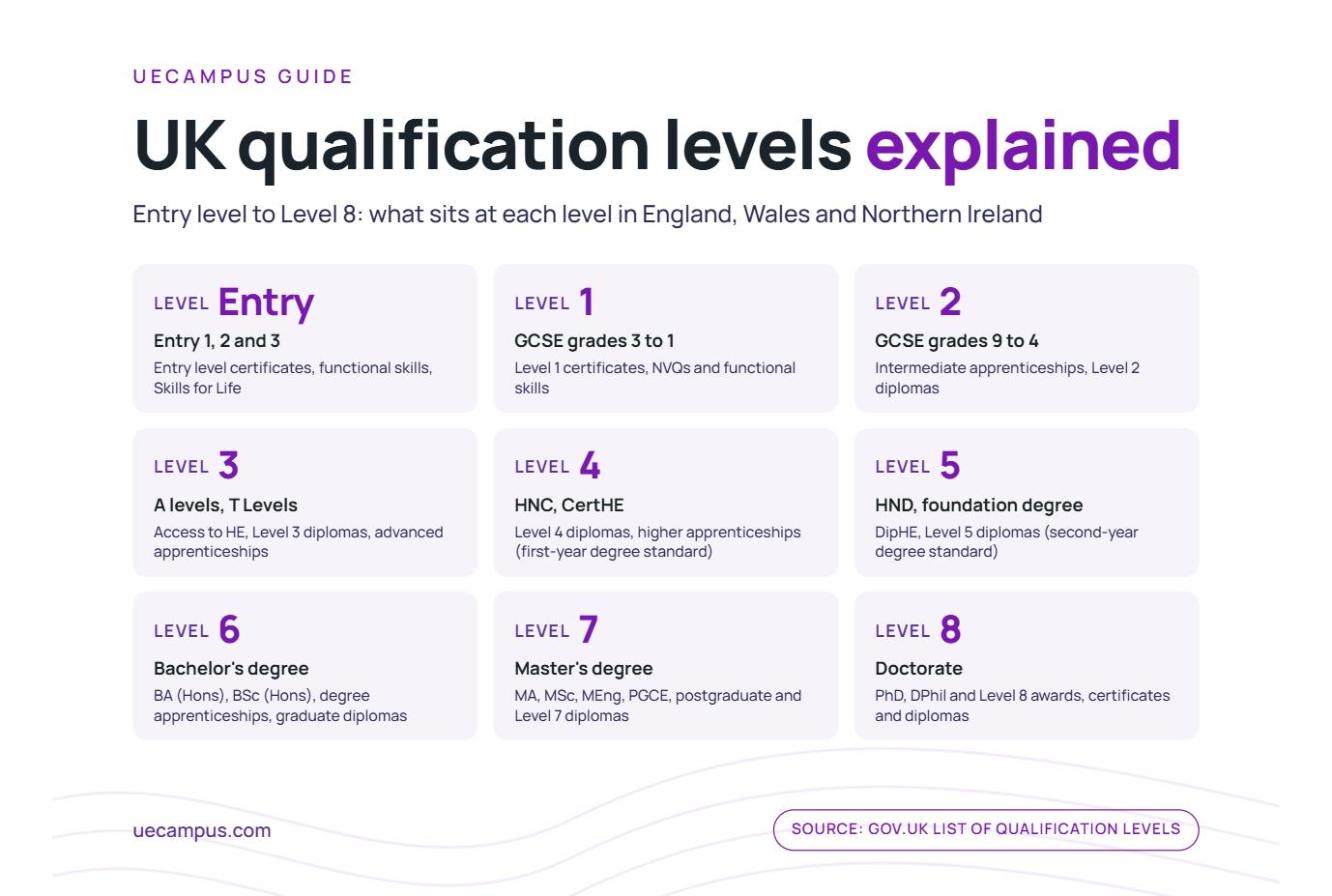
The examples below are taken from the UK government's official list of qualification levels for England, Wales and Northern Ireland. Each level also includes generic "level X award, certificate and diploma" qualifications offered by regulated awarding organisations.
- Entry level. The starting point, split into Entry 1, 2 and 3, with Entry 3 the most demanding. Examples: entry level certificates, entry level functional skills, Skills for Life and entry level ESOL.
- Level 1. Examples: GCSE grades 3, 2 and 1 (or D to G under the old lettered grades), Level 1 functional skills, Level 1 NVQs and music grades 1 to 3.
- Level 2. Examples: GCSE grades 9 to 4 (or A* to C), intermediate apprenticeships, Level 2 national certificates and diplomas, Level 2 NVQs, O level grades A to C and music grades 4 and 5.
- Level 3. Examples: A levels, AS levels, the International Baccalaureate diploma, T Levels, access to higher education diplomas, advanced apprenticeships and Level 3 diplomas. This is the usual entry standard for higher education. See what a Level 3 diploma is.
- Level 4. Examples: the Certificate of Higher Education (CertHE), the Higher National Certificate (HNC), higher apprenticeships and Level 4 diplomas. Broadly the standard of the first year of a bachelor's degree. See what a Level 4 diploma is.
- Level 5. Examples: the Higher National Diploma (HND), foundation degrees, the Diploma of Higher Education (DipHE) and Level 5 diplomas. Broadly the standard of the second year of a bachelor's degree. See what a Level 5 diploma is.
- Level 6. Examples: a degree with honours such as a BA (Hons) or BSc (Hons), an ordinary degree without honours, degree apprenticeships, graduate diplomas and Level 6 diplomas.
- Level 7. Examples: master's degrees such as an MA or MSc, integrated master's degrees such as an MEng, postgraduate certificates and diplomas, the PGCE and Level 7 diplomas. See what a Level 7 diploma is.
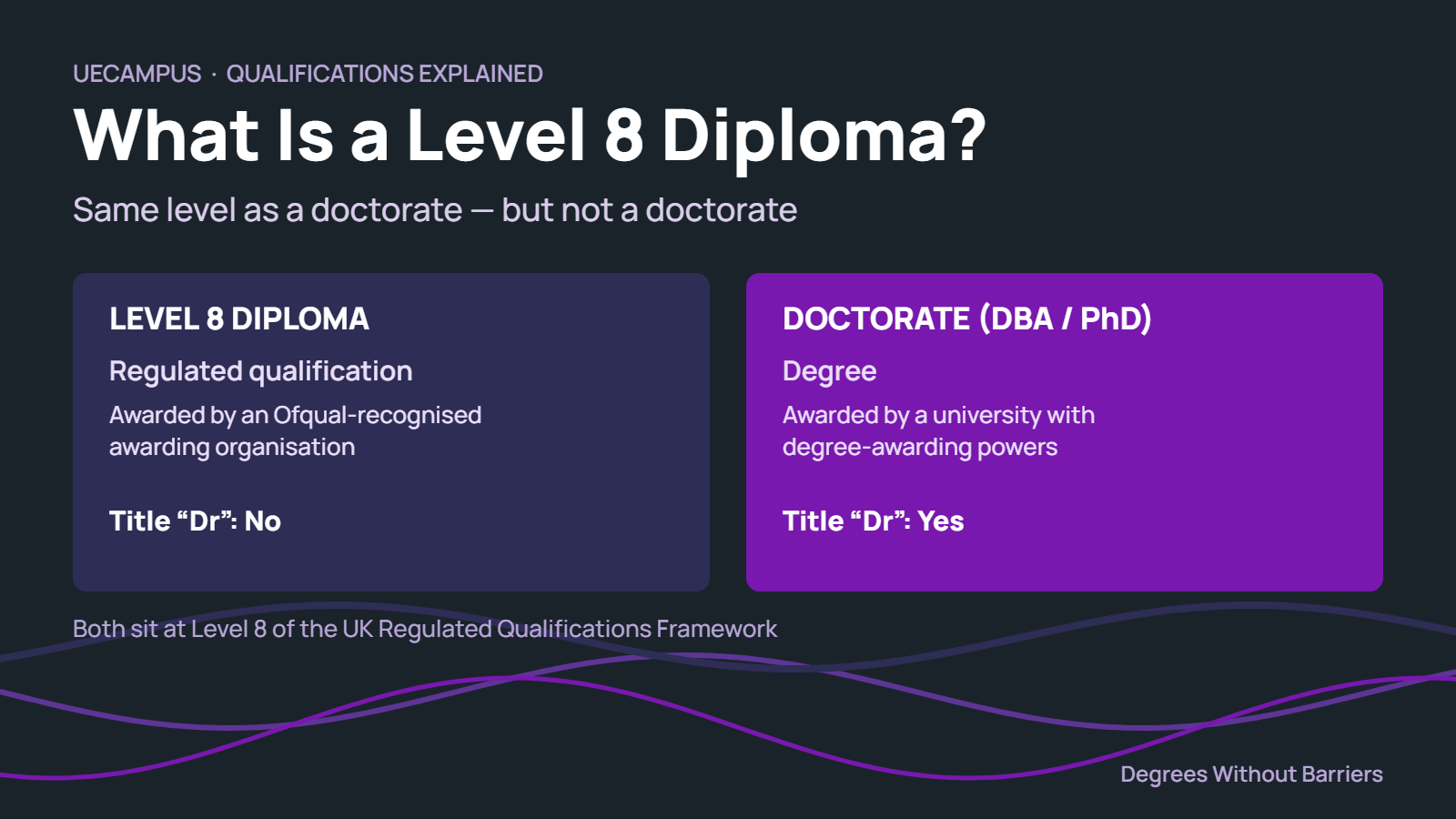
- Level 8. Examples: doctorates such as a PhD or DPhil, and Level 8 awards, certificates and diplomas. See what a Level 8 diploma is.
Level 6 and the degree question
The most common misunderstanding about the levels is the word "equivalent". A Level 5 diploma is at the same standard as the second year of a degree, and a Level 7 diploma is at the same standard as a master's, but neither is a degree. The level tells you the standard; the title and the awarding institution tell you what you actually hold. A bachelor's degree with honours is the Level 6 benchmark, and in the UK it is awarded by a university or another body with degree-awarding powers, normally for 360 credits of study. A Level 6 diploma from an awarding organisation sits at the same standard but is usually smaller and is not a degree.
This is why the normal route from a diploma to a degree is a top-up: a holder of a 240-credit Level 5 qualification applies for the final year of a bachelor's degree, and the university decides whether to admit them and with how much credit. Our guide to top-up degrees explains how that works and what universities look for.
Scotland, Europe and the rest of the world
Scotland does not use this scale. The Scottish Credit and Qualifications Framework (SCQF) has twelve levels, so the numbers do not match one for one: an SCQF Level 6 qualification sits at the same standard as Level 3, SCQF Level 7 matches Level 4 and SCQF Level 8 matches Level 5. If you are looking at an SCQF credit-rated certificate or diploma, our SCQF guide sets out the full comparison and what it means for progression.
Across Europe, the European Qualifications Framework (EQF) is the common reference scale, and regulated UK qualifications carry an EQF level on the official register: a UK Level 4 or Level 5 qualification is referenced to EQF Level 5, for example. Outside Europe there is no automatic mapping. The government's guidance points to UK ENIC, the UK's national information centre, which compares UK and non-UK qualifications for a fee, and every university and employer applies its own policy. Degrees awarded by universities outside the UK, including the American and European degrees available through UeCampus, are not placed on the UK framework at all; they are compared against it when you apply for further study or a job, which is one reason accreditation evidence matters so much for those degrees.
How the levels are used in practice
- Entry requirements. Programmes usually ask for a qualification at the level below. A Level 4 diploma typically asks for Level 3 or relevant experience; a Level 7 diploma typically asks for a bachelor's degree or substantial management experience. Because the levels are defined, moving up one level at a time is the most predictable progression route.
- Job adverts. Employers in the UK often write requirements as "qualified to Level 3" or "degree level (Level 6) or above". Knowing your level lets you answer that question precisely, whatever the title of your qualification.
- Comparing offers. Two programmes at the same level can differ greatly in size, so compare credits and total qualification time, not just the level number. A 120-credit Level 7 diploma and a 180-credit master's degree are both Level 7, but one is two thirds the size of the other.
- Checking claims. For any regulated qualification in England, the level, credit value and awarding organisation are public on Ofqual's register. If a provider cannot tell you the qualification number and level, treat that as a warning sign.
Which level should you start at?
Match your starting point to the level below the one you want to enter.
- No A levels, or you left school early: start at Level 3 (or an SCQF Level 6 diploma), which prepares you for higher study and is often accepted for entry to Level 4.
- A levels or an equivalent Level 3 qualification: you can enter a Level 4 diploma, a Level 4 and 5 route that builds towards a top-up, or a bachelor's degree directly.
- An HND, a 240-credit Level 5 qualification or an SCQF Level 8 diploma: a final-year top-up to a bachelor's degree is the usual next step, subject to the university's admission decision.
- A bachelor's degree: a Level 7 diploma, a master's or an MBA. If you do not hold a degree but have significant experience, our article on MBA routes without a bachelor's degree explains the options.
- A master's degree: a Level 8 diploma, a DBA or a PhD. Our comparison of the DBA and PhD will help you decide which suits your goals.
If your qualifications come from outside the UK, ask admissions to confirm how they are being compared before you commit. UeCampus advisers do this routinely and can tell you which level and route they would recommend.
Where UeCampus programmes sit, level by level
- Level 2: the Qualifi Level 2 Diploma in Business Beginners in Cyber Security, a starting point for complete beginners.
- Level 3: the Qualifi Level 3 Diploma in Business Management, the Level 3 Extended Diploma in IT and Data Science and, on the Scottish scale, the EduQual Diploma in Business and Management (SCQF Level 6) and the EduQual Diploma in International Foundation Studies (SCQF Level 6).
- Level 4: Qualifi Level 4 diplomas in Business Management, Accounting and Finance, Information Technology, Cyber Security, Psychology, Artificial Intelligence and Hospitality and Tourism Management, plus EduQual SCQF Level 7 certificates in Business and Management, Cyber Security, Creative Computing, Creative Media and Psychology.
- Level 5: the Qualifi Level 5 Extended Diploma in Business Management and Level 5 diplomas in Accounting and Finance, Information Technology, Cyber Security, Psychology, Hospitality and Tourism Management and Artificial Intelligence, plus EduQual SCQF Level 8 diplomas in Business and Management, Cyber Security, Creative Computing, Creative Media and Psychology.
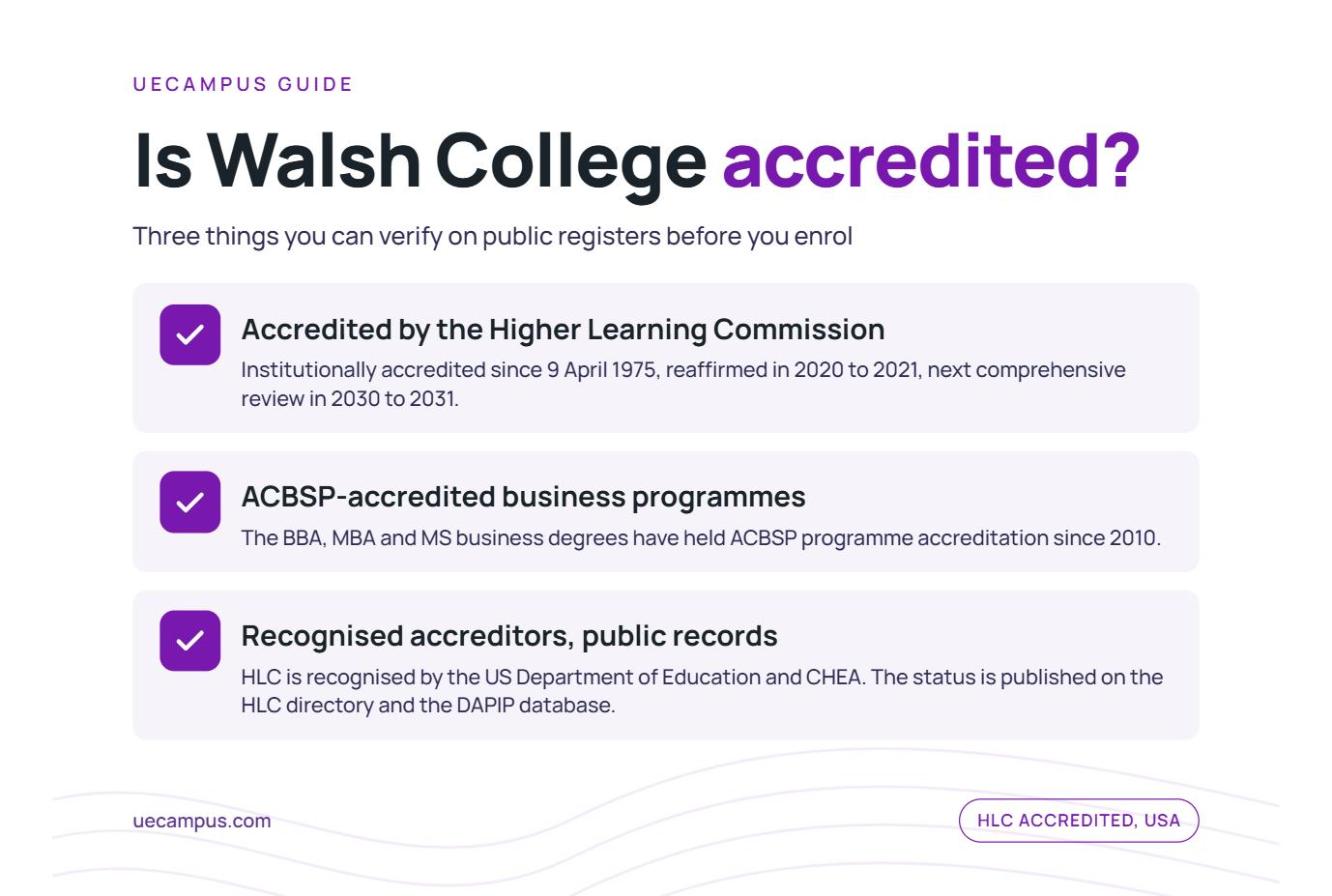
- Bachelor's degree standard (Level 6 benchmark): BBA, BA and BSc degrees awarded by UeCampus's university partners, Walsh College in the United States, eie European Business School in Malta and PPA Business School in Paris.
- Level 7: Qualifi Level 7 diplomas in Strategic Management and Leadership, Accounting and Finance, Human Resource Management, Strategic Marketing, Information Technology, Data Science, Psychology, Education Management and Leadership and Hospitality and Tourism Management, alongside master's degrees and MBAs from the partner universities at the same standard.
- Level 8: the Qualifi Level 8 Diploma in Strategic Management and Leadership, and doctoral degrees such as the Doctor of Business Administration and the PhD in Organizational Leadership awarded by Walsh College.
The full programme catalogue can be filtered by level and partner. Tuition is listed on the fees page, and you can check your eligibility for a UeCampus scholarship before you apply.
Frequently asked questions
What level is an HND?
Level 5, alongside foundation degrees and the Diploma of Higher Education. An HNC is Level 4.
What level is a bachelor's degree?
Level 6. A degree with honours (BA Hons, BSc Hons) and an ordinary degree without honours are both listed at Level 6, as are degree apprenticeships and graduate diplomas.
Is a Level 7 diploma the same as a master's degree?
No. They sit at the same level, but a master's degree is normally 180 credits and awarded by a university, while a Level 7 diploma is usually smaller and awarded by a regulated awarding organisation. Some universities accept a suitable Level 7 diploma for advanced entry to a master's or MBA, always at their own discretion.
Is Level 4 the same as the first year of university?
It is the same standard. The Certificate of Higher Education, the HNC and Level 4 diplomas all sit at this level. Whether a specific Level 4 qualification gives you credit towards a degree depends on its size, its subject and the university's own rules.
What is the difference between the RQF, the QCF and the NQF?
They are successive names for the regulated framework in England and Northern Ireland. The RQF, introduced in 2015, replaced the QCF and the older NQF. The level numbers did not change, so a certificate that says "QCF Level 5" sits at the same level as a current "Level 5" qualification.
What level is an MBA?
Master's level, which is Level 7 in UK terms. An MBA from a non-UK university is not placed on the UK framework itself; it is compared against Level 7 when you use it in the UK, which is why the awarding university's accreditation is worth checking.
Next steps
Once you know your current level, choosing a programme is a matter of picking the next step up in the subject you want. Browse the UeCampus programme catalogue by level, or enquire now and the admissions team will confirm which level your existing qualifications place you at and which routes are open to you.
Thinking about studying online?
Explore accredited UeCampus programmes and UK diplomas, or speak to an admissions advisor about the next intake.
Browse programmes Enquire now