What Is a Level 2 Diploma? Is It Equivalent to GCSEs, and What Can It Lead To?
A Level 2 diploma sits at the same level as GCSEs at grades 9 to 4. Learn what the level and the word "diploma" mean, how it compares with GCSEs, and where it can take you next.
A Level 2 diploma is often the very first step back into study. Maybe you left school early, or your school grades are from another country, or you want to start a new subject such as cyber security without jumping in at the deep end. This guide explains what "Level 2" means, how it compares with GCSEs, how big a diploma is, and where it can take you next.
The short answer
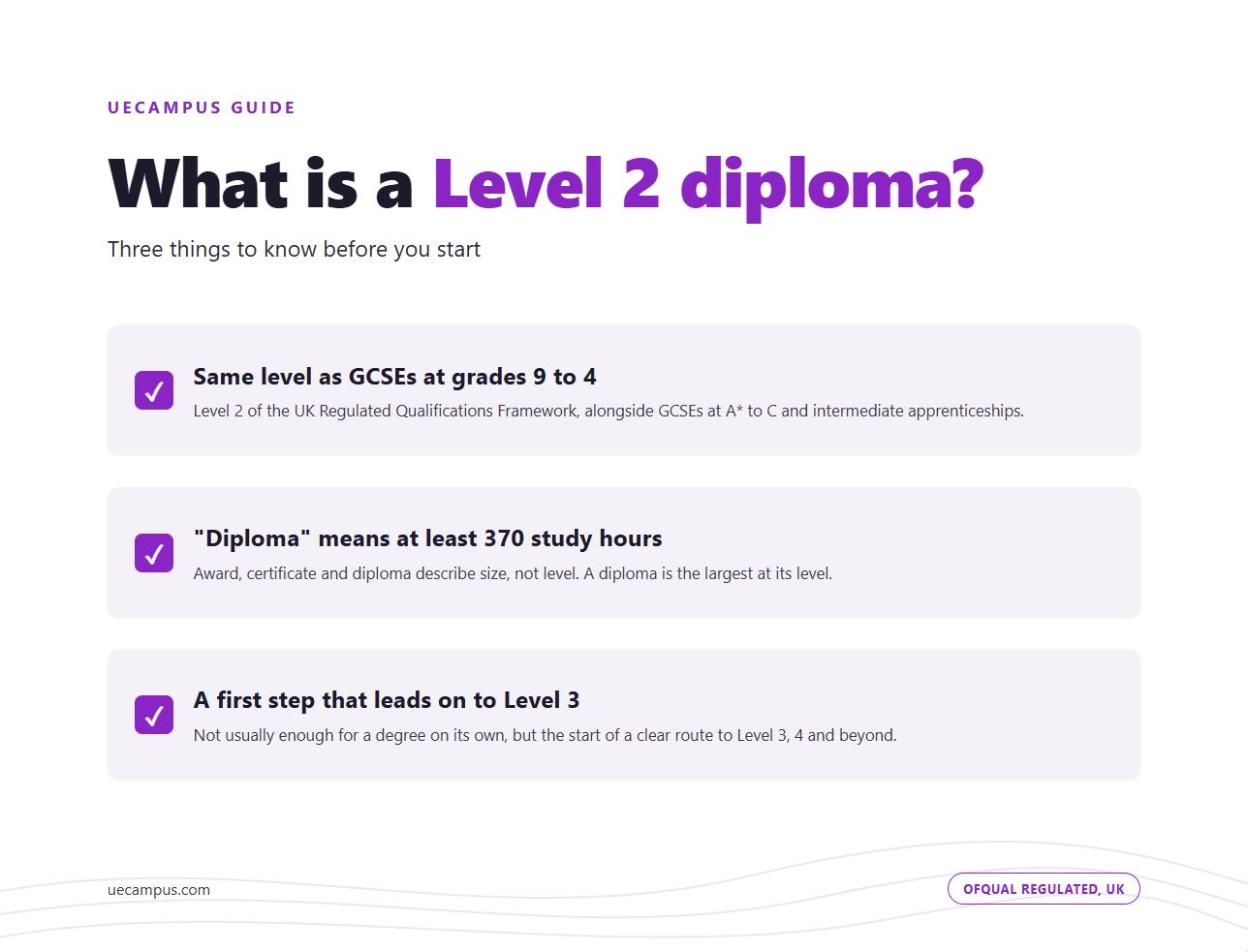
A Level 2 diploma is a qualification at Level 2 of the UK's Regulated Qualifications Framework (RQF). Level 2 is the same level as GCSEs at grades 9 to 4 (the old grades A* to C). The word "diploma" tells you the size: it is the largest type of qualification at its level, with at least 370 hours of total study time.
So a Level 2 diploma is a full, solid qualification at GCSE level. It is not a university-level qualification, and on its own it usually will not get you into a degree. Its real value is as a starting point: it builds your skills and confidence, and leads on to a Level 3 diploma, then Level 4 and beyond.
What "Level 2" means
The UK government sorts most regulated qualifications into levels, from Entry Level up to Level 8. The higher the number, the harder the qualification. GOV.UK lists these as Level 2 qualifications:
- GCSEs at grades 9, 8, 7, 6, 5 or 4 (or A*, A, B, C)
- intermediate apprenticeships
- Level 2 awards, certificates and diplomas
- Level 2 NVQs and Level 2 functional skills
So when you see "Level 2", think "good GCSE level". It shows you have solid basic knowledge of a subject and can use it in everyday work.
For the full picture, from GCSEs right up to doctorates, read our guide to UK qualification levels.
Award, certificate or diploma: what is the difference?
Many people think "diploma" means a higher level than "certificate". It does not. In the UK, these words describe the size of a qualification, not its level. Size is measured in Total Qualification Time (TQT): all the hours a typical learner spends, including teaching, reading, practice and assignments. One credit is roughly 10 hours.
| Title | Size (TQT) | Credits |
|---|---|---|
| Award | 10 to 120 hours | 1 to 12 |
| Certificate | 121 to 369 hours | 13 to 36 |
| Diploma | 370 hours or more | 37 or more |
This means a Level 2 Award and a Level 2 Diploma are at the same level, but the diploma covers much more. If you want to understand credits in more detail, see how many credits a degree is.
Is a Level 2 diploma equivalent to GCSEs?
It is at the same level as GCSEs at grades 9 to 4. That does not make it a GCSE, and it is not a direct swap for a specific number of GCSEs.
Here is the honest way to think about it:
- Same level: yes. A Level 2 diploma and a GCSE at grade 4 or above both sit at Level 2.
- Same subject cover: no. A GCSE covers one school subject. A vocational Level 2 diploma covers one work area, such as business or cyber security.
- Accepted in place of GCSEs? It depends on who is asking. Some employers and colleges are happy with any Level 2 qualification. Others ask specifically for GCSE English and maths. Always check the exact entry rules.
Is a Level 2 diploma enough to get into university?
Usually, no. UK universities normally ask for Level 3 qualifications, such as A levels or a Level 3 diploma, before a degree. A Level 2 diploma is the step before that.
The good news is that the route is clear:
- Level 2 diploma: build the basics.
- Level 3 diploma: this is the level of A levels. Read what a Level 3 diploma is.
- Level 4 and Level 5 diplomas: these are at the level of the first and second year of a degree. See what a Level 4 diploma is.
- Top-up or degree: from Level 5, many learners apply for a final-year top-up degree.
Each step needs its own application, and each provider makes its own decision. If you want to see all the ways adults reach a degree, read how to get a degree without A levels.
Who a Level 2 diploma suits
A Level 2 diploma is a good fit if you:
- are returning to study after a long break and want to start at a comfortable level
- do not have GCSEs, or your school results are from another country and you want a UK qualification to build on
- want to try a new subject before you commit to a higher level
- want a recognised qualification to show an employer you have the basics
It may not be the right start if you already have A levels, a Level 3 diploma, or a degree. In that case, you can usually start higher and save time and money.
How to check that a Level 2 diploma is properly regulated
Not every course called a "diploma" is a regulated qualification. Some are just certificates of completion from a training company. Before you enrol, check:
- Who awards it. Look for an awarding organisation regulated by Ofqual. Read what Qualifi is and how Ofqual recognition works for an example.
- The qualification number. Regulated qualifications have a number in the format 603/3329/7. You can search it on the official Ofqual Register.
- The level and size. The register shows the level, the TQT and the credits.
Example: the Qualifi Level 2 Diploma in Business Beginners in Cyber Security
UeCampus offers one Level 2 diploma: the Level 2 Diploma in Business Beginners in Cyber Security, awarded by Qualifi, a UK awarding organisation regulated by Ofqual.
Here are its public details:
- Qualification number: 603/3329/7
- Level: 2
- Size: 500 hours of Total Qualification Time, which is 50 credits. That is well above the 370 hours needed to be called a diploma.
- Type: vocationally related qualification
- Who it is for: beginners who want to understand how businesses protect their data from digital threats
- How it is assessed: assignments, not exams
- Study mode with UeCampus: 100% online, with tutor support
Qualifi designed it so that learners can move on to a Level 3 diploma when they finish. If you enjoy cyber security, you could later move on to the Qualifi Level 4 Diploma in Cyber Security once you meet its entry requirements. If you are curious about the career side, read whether an online cyber security degree is worth it.
Level 3 options to move on to with UeCampus
When you are ready for the next step, UeCampus offers these Qualifi Level 3 diplomas online:
- Qualifi Level 3 Diploma in Business Management
- Qualifi Level 3 Diploma in Integrated Business Management
- Level 3 Diploma in IT and Data Science
Each has its own entry requirements, so ask our admissions team which one fits your background.
Frequently asked questions
What level is a Level 2 diploma?
It is at Level 2 of the UK's Regulated Qualifications Framework. That is the same level as GCSEs at grades 9 to 4.
Is a Level 2 diploma higher than a Level 2 certificate?
No. They are at the same level. A diploma is simply bigger: at least 370 hours of study, compared with 121 to 369 hours for a certificate.
How long does a Level 2 diploma take?
It depends on the qualification and how many hours a week you study. The Level 2 Diploma in Business Beginners in Cyber Security is listed on UeCampus as a 6-month programme when studied online.
Can I go to university with a Level 2 diploma?
Not usually on its own. Most degrees ask for Level 3 first. A Level 2 diploma is a good first step on the way there.
Is a Level 2 diploma recognised outside the UK?
A regulated UK Level 2 diploma is a formal qualification with a published level and size. How it is used in another country depends on that country's employers and education authorities, so check locally if you need it for a specific purpose.
Next steps
If you want to start learning again, a Level 2 diploma is a low-pressure, recognised way to begin. Tell us about your past study and your goals, and we will help you choose the right starting level, whether that is Level 2 or higher.
Speak to a UeCampus admissions adviser or look at the Level 2 Diploma in Business Beginners in Cyber Security.
Thinking about studying online?
Explore accredited UeCampus programmes and UK diplomas, or speak to an admissions advisor about the next intake.
Browse programmes Enquire now