How to Get a Degree Without A Levels: 5 Routes for Adults and International Students
No A levels? You can still get a degree. Here are five recognised routes, from online Level 3 diplomas to direct-entry online bachelor's degrees, with who each one suits and how long it takes.
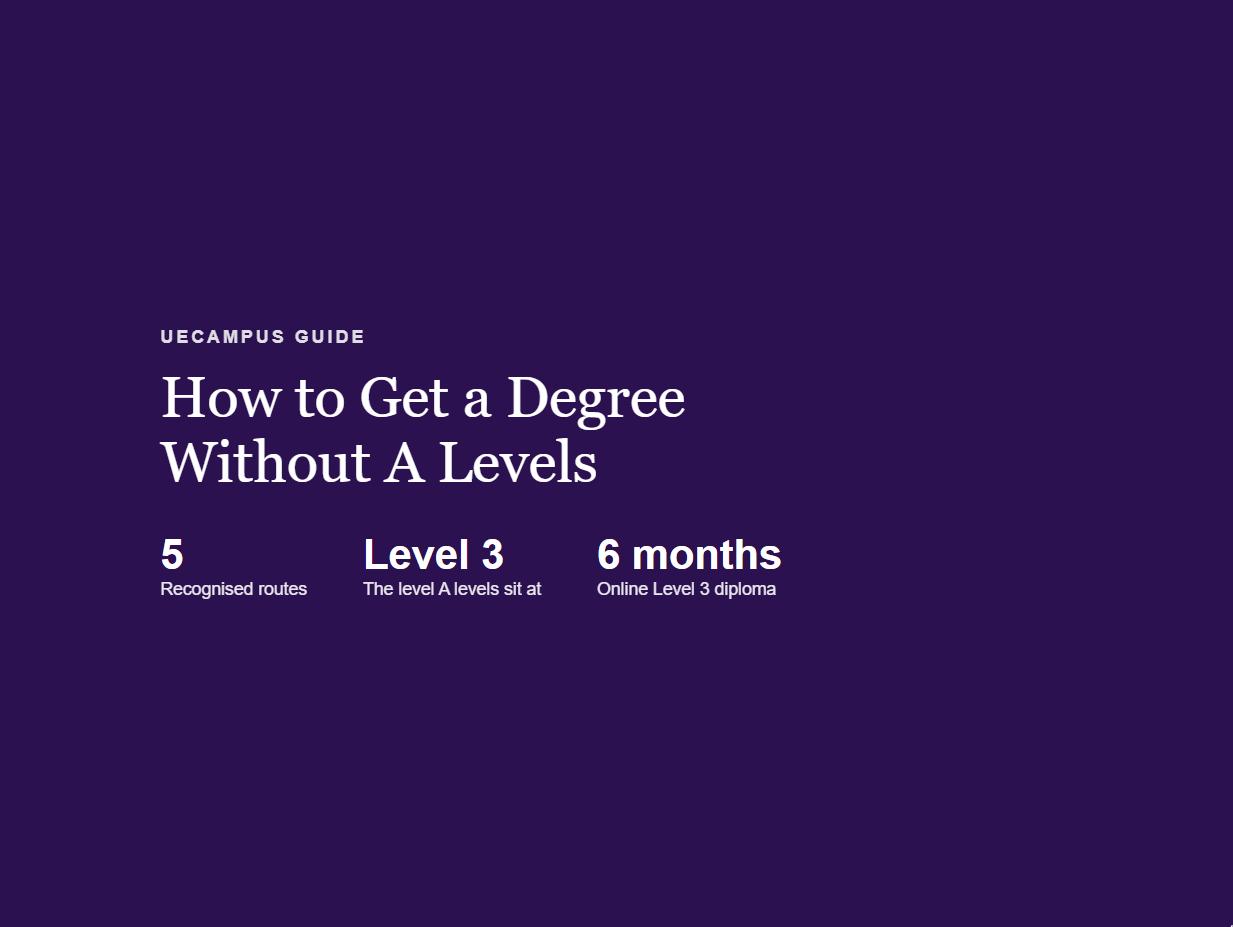
Yes, you can get a degree without A levels. A levels are only one way to reach Level 3, the standard most universities ask for before you start a bachelor's degree, and they were designed for 16 to 18 year olds in school. If you left school early, finished secondary education outside the UK, or have spent years working instead of studying, there are other recognised routes that lead to the same place. This guide walks through five of them, explains who each one suits, how long it takes, and how to choose the quickest route for your situation.
Why universities ask for A levels in the first place
When a UK university asks for A levels, what it really wants is evidence that you can study at Level 3, the level just below the first year of a degree. The UK government's list of qualification levels places many qualifications at Level 3, not just A levels. It includes the Access to Higher Education Diploma, advanced apprenticeships, the International Baccalaureate Diploma, T Levels, BTEC Nationals and Level 3 diplomas.
So the question is not "do I have A levels?" but "do I have a Level 3 qualification, or something a university will accept instead?" Our guide to UK qualification levels from 1 to 8 shows the whole ladder if you want to see where you are now.
Route 1: An online Level 3 diploma, then on to a degree
For working adults and international learners, this is often the most practical route. A regulated Level 3 diploma gives you a recognised qualification at the same level as A levels, but it is built for adults: it is studied online, assessed through written assignments rather than exams, and does not tie you to a September start.
UeCampus offers several Level 3 options, all delivered fully online:
- Qualifi Level 3 Diploma in Business Management, a six-month pathway into Level 4 and undergraduate business study
- Qualifi Level 3 Diploma in Integrated Business Management, a larger programme that adds study skills and English for higher education
- Level 3 Extended Diploma in IT and Data Science, for learners heading towards computing, data or cyber security
- EduQual Diploma in Business and Management (SCQF Level 6), a Scottish-framework diploma at the level comparable to A levels
- EduQual Diploma in International Foundation Studies (SCQF Level 6), a foundation programme for learners preparing for higher education
Once you hold Level 3, the usual next step is Level 4, then Level 5, then a one-year top-up to finish a bachelor's degree. Our guide to what a Level 3 diploma is explains how these diplomas compare with A levels in size and assessment.
Best for: adults who are working, people outside the UK, and anyone who wants a flexible start date.
Route 2: Level 4 and Level 5 diplomas, then a top-up degree
If you already have some Level 3 qualifications, or several years of relevant work experience, you may be able to start at Level 4 rather than Level 3. Awarding bodies often consider experience as well as formal qualifications at entry, so it is worth asking before you assume you have to start at the bottom.
The stepped route looks like this:
- Level 4 diploma, which sits at the level of the first year of a bachelor's degree. For example, the Qualifi Level 4 Diploma in Business Management.
- Level 5 diploma, which sits at the level of the second year. The Level 5 Extended Diploma in Business Management covers both the Level 4 and Level 5 stages in one programme.
- Top-up degree, a one-year final stage at Level 6 with a university, after which you graduate with a full bachelor's degree.
Each stage is shorter and lower in cost than a full three-year degree, and each one leaves you with a recognised qualification even if you pause between stages. Read what a Level 4 diploma is and how a top-up degree works for the detail. As with any credit transfer, the receiving university makes the final admission decision, so confirm the top-up before you rely on it.
Best for: people who want to spread cost and effort, and people with work experience who can start above Level 3.
Route 3: An online bachelor's degree with flexible entry
Some online bachelor's programmes look at your whole profile, including work experience and prior study, rather than asking for A levels specifically. If you are accepted, you go straight onto the degree.
The BA (Hons) in Business Management from eie European Business School, delivered online through UeCampus, is an honours bachelor's at Level 6 of the Malta and European Qualifications Frameworks. It has flexible eligibility, credit recognition for prior study or experience, and is designed to be completed in 1.5 to 2 years. If you would prefer a US degree, look at the online BBA from Walsh College.
Entry decisions are made case by case, so the quickest way to find out whether you qualify is to ask admissions with your current certificates and CV in hand.
Best for: experienced professionals who want the degree title as quickly as possible.
Route 4: An Access to HE Diploma
In the UK, the Access to Higher Education Diploma is a well-known Level 3 route for adults. Like A levels, it is a full Level 3 qualification accepted by higher education providers across the country. It is usually a one-year course at a further education college, and many courses are built around a subject area such as health, science or social science.
The trade-off is flexibility. Access courses usually follow the college year and are designed for people living in the UK. Before you enrol, check that the university you are aiming for accepts the specific Access diploma for your chosen degree.
Best for: UK residents aiming for a campus degree, especially in health or science subjects.
Route 5: A university foundation year
A foundation year is an extra year at the start of a degree, offered by many universities to students who do not meet the standard entry requirements. Some universities run foundation years specifically for mature students without standard qualifications.
A foundation year usually ties you to one university and adds a full year of fees to your degree. It also normally means studying on campus. If you want online study or flexibility over where you finish your degree, Routes 1 to 3 are usually a better fit.
Best for: people who already know which campus university they want to attend.
Which route is quickest for you?
| Your situation | Usually the quickest route |
|---|---|
| No qualifications after school, working full time | Online Level 3 diploma, then Level 4 and 5, then top-up |
| Finished school outside the UK | Online Level 3 or international foundation diploma |
| Several years of management or professional experience | Ask about direct entry to Level 4 or an online bachelor's |
| You want the degree title as soon as possible | Online bachelor's with flexible entry |
| You live in the UK and want a campus place | Access to HE Diploma or a foundation year |
Age is not a barrier on any of these routes. If you are worried about starting later in life, read is it too late to get a degree?
Five things to check before you choose
- Is the qualification regulated? UK diplomas should be listed on the Ofqual Register of Regulated Qualifications, which shows the level and size.
- Where does it lead? Ask which Level 4 programme or degree the qualification is designed to lead to, and get the progression route in writing.
- Do you need English language evidence? If English is not your first language, many programmes ask for IELTS or an equivalent test.
- Can your experience count? Ask whether work experience or earlier study can give you credit or let you start at a higher level.
- What is the total cost and time to a degree? Add up every stage, not just the first one, so you can compare routes fairly. Our page on tuition and fees lists UeCampus costs, and you can check scholarships too.
Frequently asked questions
Can I go to university without A levels?
Yes. Universities accept many Level 3 qualifications other than A levels, including Access to HE Diplomas, BTEC Nationals and regulated Level 3 diplomas. Some also consider mature applicants on the basis of work experience. Each university sets its own entry requirements, so check the specific course.
What is the equivalent of A levels for adults?
The main adult alternatives are the Access to HE Diploma, usually studied at a UK college, and regulated Level 3 diplomas, which can be studied online. Both sit at Level 3, the same level as A levels.
Can I get a degree online without A levels?
Yes. You can start with an online Level 3 diploma and progress through Levels 4 and 5 to a top-up degree, or apply directly to an online bachelor's programme that considers experience and prior study at entry.
How long does it take to get a degree without A levels?
It depends on your starting point. An online Level 3 diploma can take around six months. From there, Level 4 and Level 5 diplomas and a one-year top-up add the remaining stages. An online bachelor's with direct entry, such as the eie BA (Hons) in Business Management, is designed for completion in 1.5 to 2 years.
Do I need GCSEs to get into a degree?
Many UK universities ask for GCSE English and maths or equivalent, but requirements vary, especially for mature and international applicants. Level 3 diploma programmes typically accept Level 2 qualifications, relevant work experience, or an interview for experienced learners without formal qualifications.
Is a degree earned without A levels worth less?
No. Once you graduate, your degree certificate shows the degree you earned, not the route you took to get onto it. Employers care about the degree and your experience. For more on how employers view online study, read can you get a job with an online degree?
Next steps
Not having A levels does not close the door to a degree. It just means choosing a different first step. If you are starting from scratch, look at the Level 3 Diploma in Business Management. If you have experience, ask whether you can start at Level 4 or go straight onto the online BA (Hons) in Business Management. You can also browse the full programme directory or follow our step-by-step guide to applying for an online degree.
Not sure where you should start? Enquire now and the UeCampus admissions team will look at your certificates and experience and tell you the fastest route to a degree.
Thinking about studying online?
Explore accredited UeCampus programmes and UK diplomas, or speak to an admissions advisor about the next intake.
Browse programmes Enquire now