What Is a Level 6 Diploma? Is It Equivalent to a Bachelor's Degree, and What Can It Lead To?
A Level 6 diploma sits at the same level as a bachelor's degree but is not a degree. Here is how the credits compare, what it can lead to, and the online routes to Level 6 for working adults.
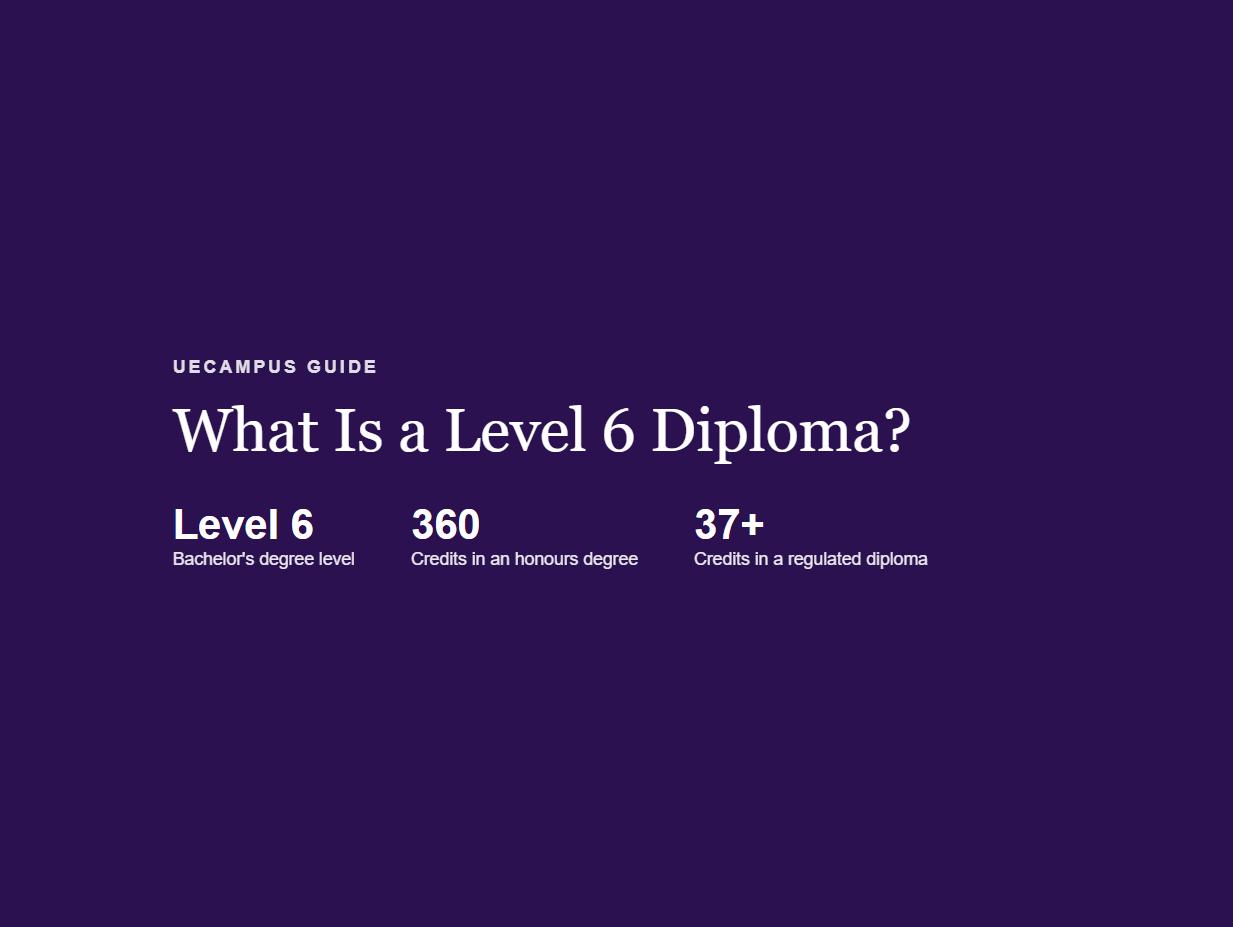
A Level 6 diploma is a qualification that sits at the same level as a bachelor's degree with honours in the UK framework, but it is not a bachelor's degree. It is usually much smaller than a full degree, it is awarded by a regulated awarding organisation rather than a university, and it does not give you a degree title on its own. What it does give you is recognised, graduate-level learning that employers can check and that can help you move on to a Level 7 diploma, a master's or an MBA. This guide explains what Level 6 means, how a Level 6 diploma compares with a degree, the different ways adults reach Level 6 online, and what to check before you choose a route.
What "Level 6" actually means
In England, Wales and Northern Ireland, qualifications are arranged on a ladder of levels from Entry Level up to Level 8. The higher the number, the harder the learning. The UK government's list of qualification levels places all of the following at Level 6:
- bachelor's degrees with honours, such as a BA (Hons) or BSc (Hons)
- ordinary bachelor's degrees without honours
- degree apprenticeships
- graduate diplomas
- Level 6 diplomas, certificates and awards
- Level 6 NVQs
So "Level 6" is the level of the final year of an honours degree. Level 5 sits just below it (foundation degrees, HNDs and Level 5 diplomas), and Level 7 sits just above it (master's degrees, postgraduate diplomas and Level 7 diplomas). If you want the full ladder in one place, our guide to UK qualification levels from 1 to 8 sets it out step by step.
The key idea is that a level describes how difficult the learning is, not how much of it there is. Two qualifications can both be Level 6 and still be very different in size, purpose and title.
Level 6 diploma vs bachelor's degree: the differences that matter
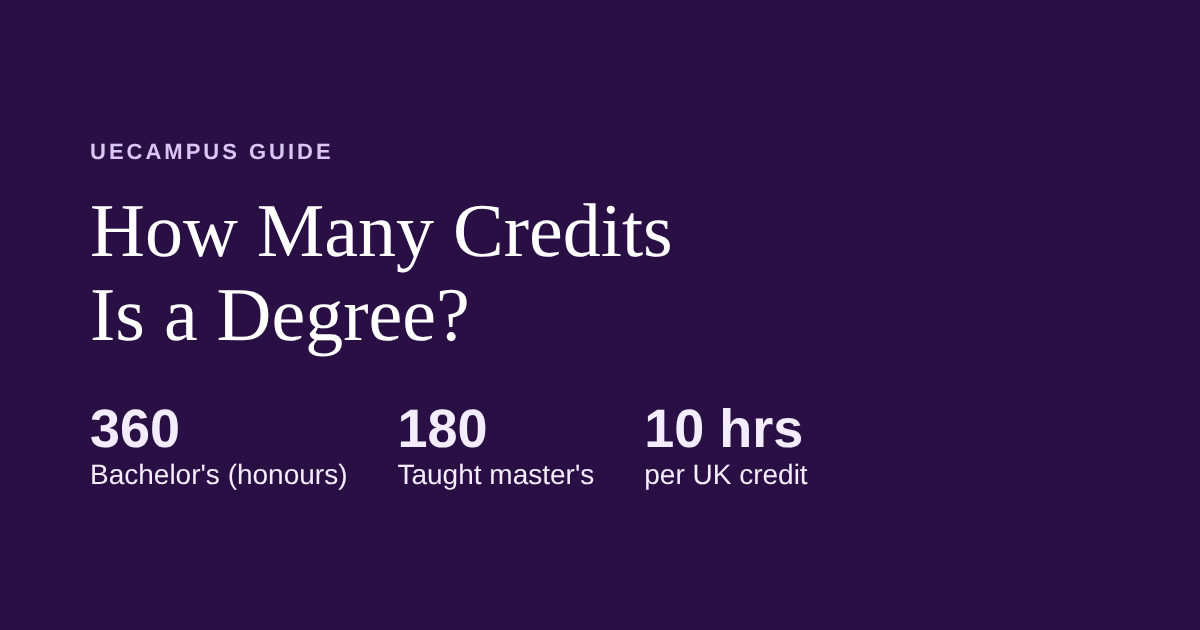
The easiest way to see the difference is to compare credits. In UK higher education, one credit stands for about ten hours of learning, including study time and assessment. The QAA's Higher Education Credit Framework for England gives the typical size of each Level 6 university award, and Ofqual's rules set the minimum size of a regulated diploma.
| Qualification | Typical minimum credits | Credits at Level 6 | Awarded by |
|---|---|---|---|
| Graduate certificate | 40 | 40 | University |
| Graduate diploma | 80 | 80 | University |
| Level 6 diploma (regulated) | 37 or more; check the specific qualification | Set by the awarding organisation | Ofqual-regulated awarding organisation |
| Ordinary bachelor's degree | 300 | at least 60 | University |
| Bachelor's degree with honours | 360 | at least 90 | University |
Three things stand out from that table.
- A Level 6 diploma is a fraction of a full degree. An honours degree is normally 360 credits spread over three years of study at Levels 4, 5 and 6. A Level 6 diploma covers the Level 6 part only, and often less than a full year of it.
- "Diploma" describes size, not prestige. Under Ofqual's rules, a regulated qualification can be called a diploma once its total qualification time reaches 370 hours, which is roughly 37 credits. Some Level 6 diplomas are around that size and others are much larger, so always look up the exact credit value on the Ofqual Register of Regulated Qualifications.
- The awarding body is different. A bachelor's degree is awarded by a university or college with degree-awarding powers. A Level 6 diploma is awarded by an awarding organisation regulated by Ofqual. It is a genuine, checkable qualification, but it is not a degree.
For a wider explanation of how credits work across the UK, Europe and the US, see our guide to how many credits a degree is worth.
So, is a Level 6 diploma equivalent to a degree?
The honest answer is: it is equivalent in level, but not in size or title.
A Level 6 diploma shows that you have studied at the same standard as the final year of a bachelor's degree. That matters. It tells employers and universities that you can work with complex ideas, analyse evidence and make decisions at graduate standard. But it does not mean you hold a bachelor's degree, and you should not describe it that way on a CV or an application form.
This distinction is important when a job advert, visa rule or master's programme asks for "a bachelor's degree or equivalent". Some will accept a Level 6 diploma together with work experience. Others ask specifically for a degree. If the degree title itself is what you need, the better choice is a route that ends in a full bachelor's degree, which we cover below.
Three ways to reach Level 6 as a working adult
Most people searching for a Level 6 diploma are really asking a bigger question: "How do I get to graduate level without giving up my job?" There are three main routes, and they lead to different results.
1. A full online bachelor's degree
If you do not yet have any higher education, a full online bachelor's degree takes you from the start to an honours degree in one programme. This is the right route if you need the degree title for your career or for a master's later.
Through UeCampus you can study, for example, the BA (Hons) in Business Management from eie European Business School. It is a fully online honours bachelor's at Level 6 of the Malta and European Qualifications Frameworks (the European level for bachelor's degrees), designed to be completed in 1.5 to 2 years, with credit recognition for relevant prior study or experience. Related options include the Bachelor of Arts in Accountancy and Finance and the Bachelor of Arts in Tourism and Hospitality Management. If you would prefer a US degree, the online BBA from Walsh College is another option.
2. Level 4 and Level 5 diplomas, then a top-up degree
This is the stepped route that many adults choose because each stage is shorter and lower in cost. You complete a regulated Level 4 and Level 5 diploma (or an extended Level 5 diploma that covers both stages), which together are designed to match the first two years of a UK bachelor's degree. You then apply to a university for a one-year "top-up", which is the 120-credit Level 6 final year of a bachelor's degree. When you pass, you graduate with the full honours degree.
A good starting point here is the Level 5 Extended Diploma in Business Management. Our guides to what a Level 5 diploma is and how a top-up degree works explain this route in detail. As with any credit transfer, each university makes its own admission decision, so confirm the top-up route before you rely on it.
3. A stand-alone Level 6 diploma
A Level 6 diploma on its own makes most sense if you already have a degree or substantial experience and want a focused, practical qualification in a specialist area, or if your employer or professional body asks for a specific Level 6 award. It gives you graduate-level learning in less time than a degree, but it does not finish with a degree title.
For many readers, routes 1 and 2 are the stronger choice, because they end with a full bachelor's degree that opens more doors later.
What can a Level 6 qualification lead to?
Once you hold a Level 6 qualification, whether that is a bachelor's degree or a Level 6 diploma, the next step up is Level 7. That is the level of master's degrees, MBAs and Level 7 diplomas.
- A Level 7 diploma. Awarding bodies typically ask for a bachelor's degree or a Level 6 qualification, or relevant management experience. Popular online options with UeCampus include the Level 7 Diploma in Strategic Management and Leadership, the Level 7 Diploma in Human Resource Management, the Level 7 Diploma in Accounting and Finance and the Level 7 Diploma in Psychology. Our guide to what a Level 7 diploma is explains how these can lead on to an MBA.
- A master's degree or MBA. Most master's programmes ask for a bachelor's degree. Some will consider a Level 6 or Level 7 diploma plus work experience instead. If you do not have a degree, read whether you can do an MBA without a bachelor's degree.
- Career progression. In the UK, the Level 6 label tells employers you have studied at graduate standard, and a regulated qualification can be checked on the Ofqual register in minutes.
Is a Level 6 diploma recognised outside the UK?
Recognition depends on the country and on who is reading your certificate. UK Level 6 lines up with Level 6 of the European Qualifications Framework, and in Scotland it compares with SCQF Levels 9 and 10. Our article on SCQF levels shows how the Scottish and UK ladders match.
In other regions, including the Gulf, South Asia and Africa, employers and ministries may ask for an overseas qualification to be compared against their own national framework. A regulated Level 6 diploma has a clear level and size, which makes that comparison easier, but it is still a diploma rather than a degree. If you need a qualification for a government job, licence or equivalency process, a full bachelor's degree is usually the safer choice. For a straight explanation of what accreditation and regulation do and do not promise, read are online degrees actually recognised?
Which route is right for you?
| Your situation | Usually the best route |
|---|---|
| No higher education yet, and you need a degree title | A full online bachelor's degree |
| You want to study in smaller, lower-cost steps | Level 4 and 5 diplomas, then a top-up year |
| You already hold an HND, foundation degree or Level 5 diploma | A one-year top-up to a bachelor's degree |
| You already have a degree and want to move up | A Level 7 diploma, master's or MBA |
| You need a specialist graduate-level skill quickly | A stand-alone Level 6 diploma |
If you are still deciding between a diploma and a degree in general, our comparison of online diplomas and degrees covers the trade-offs.
Frequently asked questions
Is a Level 6 diploma the same as a bachelor's degree?
No. Both sit at Level 6, so the learning is pitched at the same standard, but a bachelor's degree with honours is normally 360 credits awarded by a university, while a Level 6 diploma is a smaller qualification awarded by an Ofqual-regulated awarding organisation. A Level 6 diploma does not give you a degree title.
Is Level 6 higher than Level 5?
Yes. Level 5 includes HNDs, foundation degrees and Level 5 diplomas, which are similar to the second year of a degree. Level 6 is the level of the final year of a bachelor's degree with honours.
Can I do a master's with a Level 6 diploma?
Sometimes. Many universities ask for a bachelor's degree, but some will consider a Level 6 or Level 7 diploma together with relevant work experience. Check the entry requirements of the specific programme before you apply.
How long does it take to reach Level 6 online?
It depends on the route. A full online bachelor's such as the eie BA (Hons) in Business Management is designed to be completed in 1.5 to 2 years. A top-up year is usually around 12 months if you already hold a Level 5 qualification. A stand-alone Level 6 diploma can be shorter, depending on its size.
How do I check whether a Level 6 diploma is genuine?
Search for the qualification title or its qualification number on the Ofqual Register of Regulated Qualifications. The register shows the level, the credit value, the total qualification time and the awarding organisation.
Is a Level 6 diploma worth it?
It can be, if you need focused, graduate-level learning and already have a degree or strong experience. If your main goal is to hold a bachelor's degree, a full online degree or a top-up route is usually better value, because it ends with the degree title itself.
Next steps
If you want to reach graduate level without stepping away from work, start by deciding whether you need the degree title or the learning. If it is the degree, look at the online BA (Hons) in Business Management or the stepped route through the Level 5 Extended Diploma in Business Management. If you already have a degree, the Level 7 Diploma in Strategic Management and Leadership is the natural next step. You can also browse the full programme directory, check tuition and fees and see whether you qualify for a scholarship.
Not sure which route fits? Enquire now and the UeCampus admissions team will look at your current qualifications and experience and tell you the quickest way to reach Level 6 and beyond.
Thinking about studying online?
Explore accredited UeCampus programmes and UK diplomas, or speak to an admissions advisor about the next intake.
Browse programmes Enquire now