What Is a Level 3 Diploma? Is It Equivalent to A Levels, and Can It Get You Into a Degree?
A Level 3 diploma sits at the same level as A levels and is the step before Level 4, the first year of a degree. Learn what Level 3 means, how it compares with A levels, Access to HE and BTEC Nationals, how many credits it carries, how long it takes, and what it leads to.
A Level 3 diploma sits at the same level as A levels on the UK qualification framework. It is the step just below the first year of a bachelor's degree, which makes it the natural starting point if you left school without A levels, finished secondary school outside the UK, or want to get back into study before committing to a full degree. This guide explains what "Level 3" actually means, how a Level 3 diploma compares with A levels, an Access to HE Diploma and a BTEC National, how long it takes, and how it leads to Level 4 and a degree.
What "Level 3" actually means
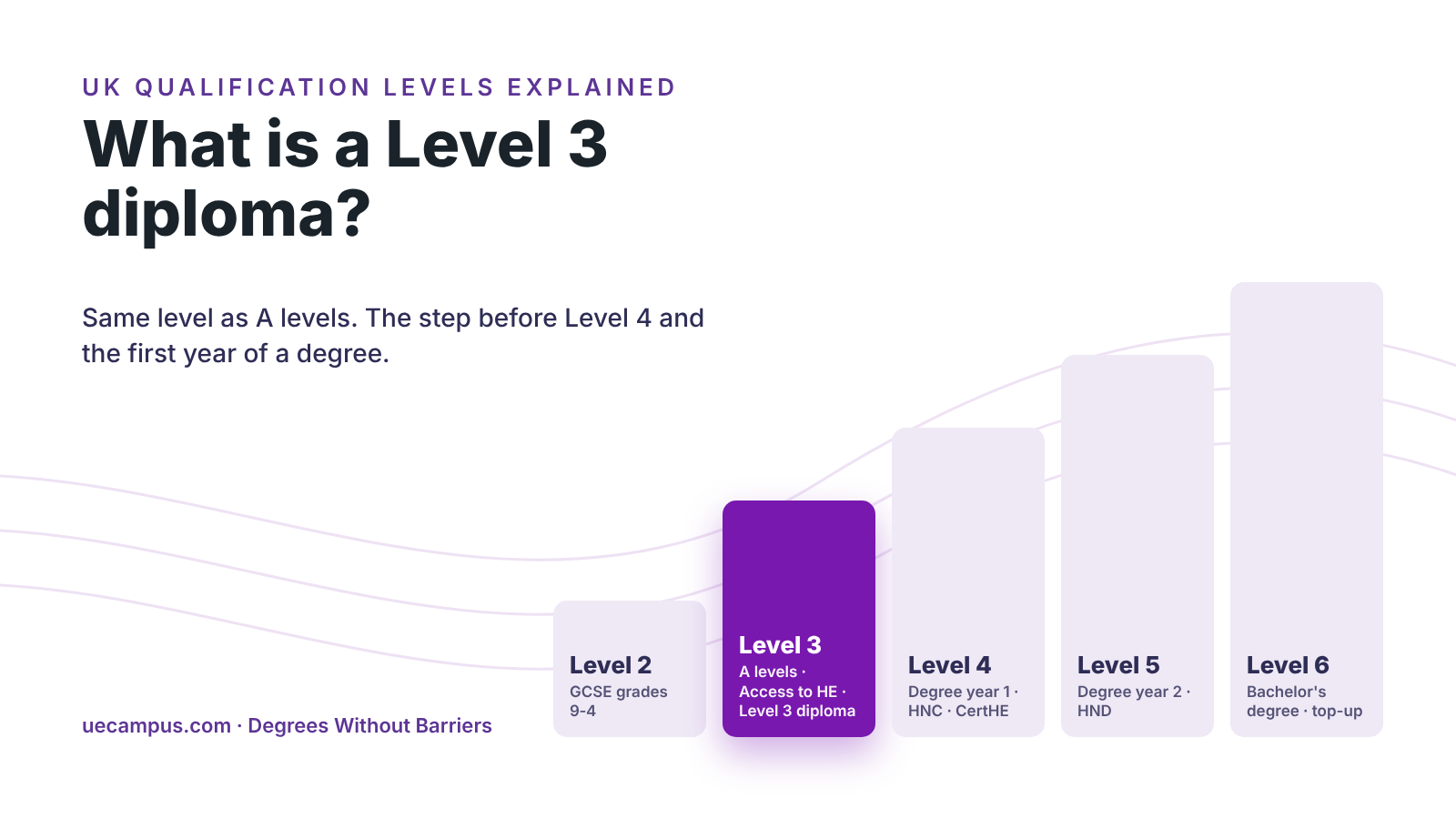
In England, Wales and Northern Ireland, qualifications are placed on a scale from Entry Level up to Level 8 under the Regulated Qualifications Framework (RQF). The number tells you how demanding a qualification is, not how big it is or what subject it covers. The UK government's list of qualification levels places the following at Level 3:
- A levels and AS levels
- Access to Higher Education Diploma
- Advanced apprenticeship
- International Baccalaureate Diploma
- T Levels and tech levels
- Level 3 award, Level 3 certificate and Level 3 diploma
- Level 3 NVQ, and Level 3 national certificate or national diploma (the BTEC Nationals)
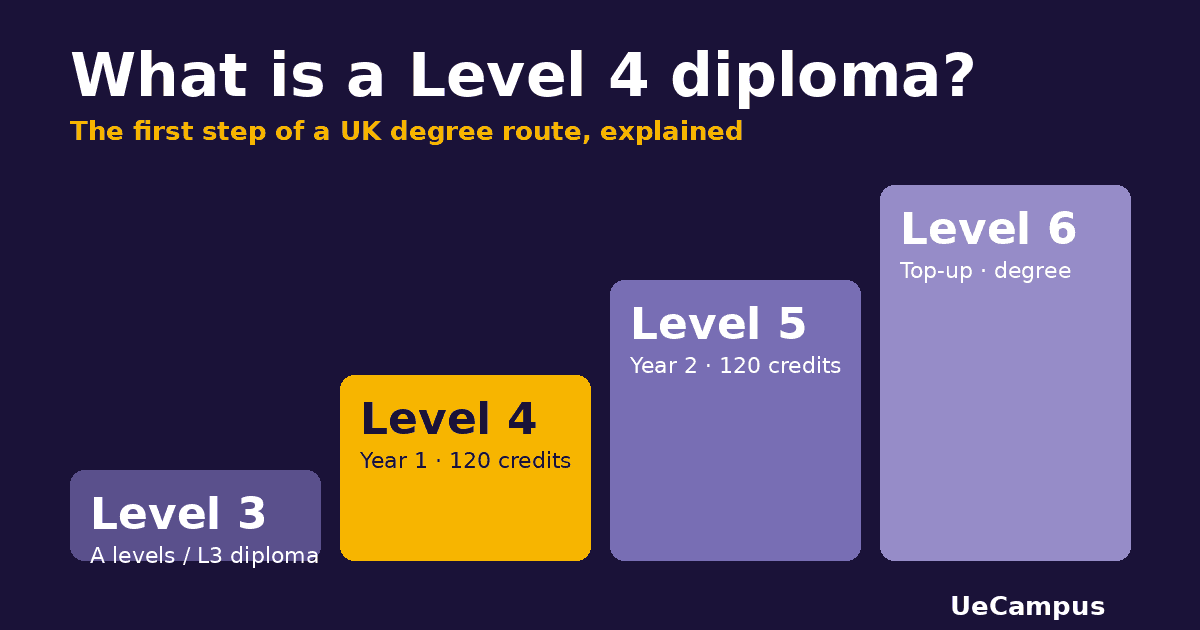
So a Level 3 diploma is one of several routes through the same level. Below it, Level 2 is where GCSEs at grades 9 to 4 sit. Above it, Level 4 is the first year of a bachelor's degree, alongside the HNC and CertHE. If you want to see what comes next, read our guide to what a Level 4 diploma is.
In Scotland the scale is different. The Scottish Credit and Qualifications Framework (SCQF) runs from level 1 to level 12, and the SCQF Partnership states that a Higher at SCQF level 6 is comparable to an A level at RQF Level 3. That is why an SCQF Level 6 diploma is usually described as equivalent to an RQF Level 3 qualification.
Is a Level 3 diploma equivalent to A levels?
It is at the same level as A levels, but "same level" does not automatically mean "same size" or "same purpose". Three things are worth separating:
- Level is about difficulty. A Level 3 diploma and an A level are both Level 3, so the thinking skills expected are broadly comparable.
- Size is measured in credits and hours. A single A level is normally a two-year school course in one subject. Level 3 diplomas vary a great deal: a 60-credit diploma is a focused introduction to a subject, while a 120- or 180-credit diploma is a much bigger programme that covers several areas.
- Purpose differs too. A levels are academic and exam-based. Most Level 3 diplomas are vocational or applied, built around a subject area such as business, IT or psychology, and are usually assessed through coursework rather than timed exams.
Because A levels are the qualification most people take at the end of upper secondary school in the UK, a Level 3 diploma is often described internationally as roughly equivalent to completing Grade 12 or high school. Treat that as a rule of thumb. Whether a specific university or employer accepts a particular Level 3 diploma as meeting its entry requirement is always their decision, so check before you enrol if you have a specific destination in mind.
Level 3 diploma vs A levels vs Access to HE vs BTEC National
The table below compares the four Level 3 routes people most often weigh up. All four sit at the same level; they differ in who they are designed for, how they are assessed and how flexible they are.
| Route | Designed for | Assessment | Typical study pattern |
|---|---|---|---|
| A levels | School leavers, usually 16 to 18 | Mainly final written exams | Two years, in school or college, two to four subjects |
| Access to HE Diploma | Adults (normally 19+) returning to study for a UK university place | Coursework, graded at Level 3 | One year, usually at a further education college |
| BTEC National (Level 3 national diploma) | 16 to 19 year olds who prefer applied, project-based learning | Coursework plus some external assessment | Two years, full time at school or college |
| Online Level 3 diploma (for example, Qualifi) | Adults and international learners who need a flexible route into Level 4 or a degree | Written assignments, internally assessed and externally quality assured; Pass or Fail | Around six months online, with flexible start dates |
The practical difference is often timing and flexibility. If you are 30, working full time or living outside the UK, two years of A levels in a classroom is rarely realistic. An online Level 3 diploma is designed for exactly that situation. Our article on studying online at 30, 40 and beyond covers the mindset side of restarting study as an adult.
How a Level 3 diploma is structured: a worked example
To make this concrete, here is how the Qualifi Level 3 Diploma in Business Management is put together, according to Qualifi's published qualification specification. Qualifi is a UK awarding organisation regulated by Ofqual; you can read more on the UeCampus Qualifi partner page.
- Size: 60 credits, made up of six units of 10 credits each. Each unit carries 100 hours of total qualification time, so the whole diploma represents around 600 hours of learning.
- Mandatory units: An Introduction to the Business Environment, Business Resources, An Introduction to Marketing, and Human Resource Management.
- Optional units (choose two): Business Communication, Understanding Health and Safety in the Business Workplace, or Recruitment and Selection in Business.
- Assessment: every unit is assessed through a written assignment, marked by the approved centre and externally quality assured by Qualifi. There are no exams, and the grading is Pass or Fail.
- Entry: applicants must be 16 or over and would normally hold Level 2 qualifications, relevant work experience with clear career goals, or a Level 3 qualification in another subject. Learners with considerable experience but no formal qualifications can be considered after an interview. If English is not your first language, IELTS 6.0 or equivalent is required.
- Progression: Qualifi lists progression to its Level 4 qualifications, to the first year of undergraduate study in a related subject, or directly into employment.
Not every Level 3 diploma is this size. Qualifi's Level 3 Integrated Diploma in Business and Management is 120 credits across 12 units, and its Level 3 Extended Diploma in IT and Data Science is 180 credits, with 60 credits of general study skills units followed by 120 credits in the chosen subject. The larger diplomas are closer in size to a full programme of A levels and include study-skills and English-for-higher-education content specifically to prepare you for degree-level work.
Who a Level 3 diploma suits
A Level 3 diploma makes most sense in four situations.
- You left school without A levels or equivalent. A Level 3 diploma gives you the qualification universities and Level 4 programmes look for, without going back to a classroom.
- You finished secondary school outside the UK. If your school-leaving certificate is not readily recognised, or you want a UK-regulated qualification on your record before applying for a degree, a Level 3 diploma acts as a foundation year.
- You have work experience but no formal qualifications. Many Level 3 programmes accept relevant experience at entry, which lets you convert what you already know into a recognised credential.
- You want to test whether degree-level study is for you. Six months and a manageable set of assignments is a lower-risk way to find out than enrolling straight onto a three-year degree.
It is less useful if you already hold A levels, an Access to HE Diploma or a BTEC National. In that case you would normally go straight to Level 4. Our guide to Level 5 diplomas explains the next step after that.
How long does a Level 3 diploma take?
It depends on the size of the diploma and how it is delivered. A levels take two years at school. An Access to HE Diploma is usually a one-year college course. The Level 3 diplomas UeCampus delivers online are structured around six months of study, with written assignments instead of exams and one-to-one tutor support, and start dates are flexible, so you are not tied to a September start. If you need longer because of work or family commitments, that can usually be planned with the admissions team before you start.
Is a Level 3 diploma recognised?
A Level 3 diploma is recognised when it is awarded by a regulated awarding organisation and listed on the relevant national register. In England, that means an awarding body regulated by Ofqual; in Scotland, an awarding body approved by Qualifications Scotland and a qualification credit-rated on the SCQF. Both Qualifi and EduQual meet those tests for the programmes UeCampus delivers.
What "recognised" does not mean is "automatically accepted everywhere". A university decides its own entry requirements, and an employer decides what it values. A regulated Level 3 diploma meets the formal Level 3 requirement, and the larger diplomas also build the study skills that admissions teams want to see. If you are aiming at one specific university, ask them directly before you enrol. We explain how regulation and recognition work in more detail in are online degrees actually recognised?
What comes after a Level 3 diploma?
The usual route is Level 3 to Level 4, then Level 5, then a Level 6 top-up to complete a bachelor's degree. In credit terms that is the UK degree ladder: 120 credits at each of Levels 4, 5 and 6. A Level 3 diploma is the entry ticket to the first rung. From a Level 3 diploma you could move to a Qualifi Level 4 Diploma in Business Management, a Qualifi Level 4 Diploma in Information Technology, a Qualifi Level 4 Diploma in Cyber Security, a Qualifi Level 4 Diploma in Psychology, a Qualifi Level 4 Diploma in Accounting and Finance, or a Level 4 Diploma in Artificial Intelligence, depending on the subject you want to build a career in. To see how the ladder ends, read what a top-up degree is.
Level 3 diploma subjects you can study online with UeCampus
UeCampus delivers the following Level 3 and SCQF Level 6 diplomas fully online, with assignment-based assessment and no exams:
- Qualifi Level 3 Diploma in Business Management - a focused 60-credit introduction to the business environment, marketing and HR, designed as a pathway into Level 4 business study.
- Qualifi Level 3 Diploma in Integrated Business Management - a larger programme that adds finance, operations, leadership and entrepreneurship units, plus integrated study-skills and English support, so it works as a foundation or "year zero" for degree entry.
- Level 3 Extended Diploma in IT and Data Science - for learners heading towards computing, data or cyber security, combining general higher-education skills with units in computer systems, networks, Python and data analytics.
- EduQual Diploma in Business and Management (SCQF Level 6) - a 120-credit Scottish-framework diploma at the level comparable to RQF Level 3, with progression to EduQual's SCQF Level 8 diplomas.
- EduQual Diploma in International Foundation Studies (SCQF Level 6) - a 180-credit foundation programme mapped to computing, psychology and business, built for learners preparing for higher education.
If you are not yet at Level 3, the Level 2 Diploma in Business for Beginners in Cyber Security is the step before it. You can browse everything from Level 2 to doctoral level in the UeCampus programme directory.
Frequently asked questions
Is a Level 3 diploma the same as A levels?
They sit at the same level, so they are comparable in difficulty, but they differ in size, subject focus and assessment. A levels are exam-based academic subjects; a Level 3 diploma is usually a coursework-based programme in one vocational or professional area.
Can I get into university with a Level 3 diploma?
A regulated Level 3 diploma is designed to prepare you for Level 4, which is the first year of a bachelor's degree, and awarding bodies such as Qualifi list first-year undergraduate entry as a progression route. Each university sets its own entry requirements, so confirm with the institution you have in mind.
Do I need GCSEs or A levels to start a Level 3 diploma?
Usually not A levels; the diploma is the alternative to them. Most Level 3 programmes ask for Level 2 qualifications (such as GCSEs or equivalent), relevant work experience, or a Level 3 qualification in another subject, and will consider experienced learners without formal qualifications after an interview.
How many credits is a Level 3 diploma?
It varies by qualification. The Qualifi Level 3 Diploma in Business Management is 60 credits; the Qualifi Level 3 Integrated Diploma in Business and Management is 120 credits; the Qualifi Level 3 Extended Diploma in IT and Data Science is 180 credits. Always check the specific qualification.
What is the difference between Level 3 and Level 4?
Level 3 is the level of A levels and prepares you for higher education. Level 4 is higher education: it is the level of the first year of a bachelor's degree, an HNC or a CertHE. Completing Level 3 is the normal condition for starting Level 4.
Is an SCQF Level 6 diploma the same as a Level 3 diploma?
Broadly yes. The SCQF Partnership compares SCQF level 6 (the level of a Scottish Higher) with RQF Level 3 (the level of an A level), so an SCQF Level 6 diploma is normally treated as equivalent to a Level 3 qualification.
Next steps
If you are deciding whether a Level 3 diploma is the right starting point, the simplest test is this: do you already hold A levels, an Access to HE Diploma or an equivalent school-leaving qualification that your target university accepts? If yes, look at Level 4. If no, or if you are unsure, a six-month online Level 3 diploma is the most direct way to earn the qualification you need and to prove to yourself that degree-level study is manageable.
Thinking about studying online?
Compare the Level 3 options above, or talk to the UeCampus admissions team about which level you should start at and how the Level 3 to Level 6 pathway would work for you. If cost is a concern, see the UeCampus scholarships and financial support page. When you are ready, our step-by-step guide to applying for an online degree walks you through the process.
Thinking about studying online?
Explore accredited UeCampus programmes and UK diplomas, or speak to an admissions advisor about the next intake.
Browse programmes Enquire now